
Emmanuel Macron’s first prime minister on Tuesday urged the cornered French head of state to resign in a shock call that compounded an escalating political crisis.
The intervention by Edouard Philippe, Macron’s longest-serving prime minister from 2017 to 2020 and who now heads an allied political party, came as frustration grew even within the president’s own camp over the biggest domestic political crisis of his eight years in office.
Prime Minister Sebastien Lecornu, appointed less than a month ago, stepped down on Monday morning after failing to rally support across the centre-right coalition for his new government, which is also only supported by a minority in parliament.
Macron ordered him to make a last-ditch effort to rally support for a coalition government, but there was no sign of progress with the far-right refusing to even attend a meeting.
France’s next presidential elections are scheduled to take place in 2027 and are seen as a historic crossroads in French politics, with the French far right under Marine Le Pen sensing its best chance yet of taking power.
Macron is constitutionally barred from seeking a third mandate.
Philippe, who has already declared he will stand, said the polls should be held early once a budget is passed, in comments Le Parisien daily described as “political bomb”.
Denouncing a “distressing political game”, he said it was up to Macron to help France “emerge in an orderly and dignified manner from a political crisis that is harming the country”.
“He must take the decision that is worthy of his function, which is to guarantee the continuity of the institutions by leaving in an orderly manner,” Philippe told the RTL broadcaster.
France has been locked in a political crisis since Macron’s gamble to hold legislative elections in the summer of 2024 backfired and resulted in a hung parliament and a strengthened far right.
In a scathing editorial, the Le Monde daily said the crisis was “yet another demonstration of the unravelling” of Macron’s second mandate following his win in the 2022 presidential elections.
“The president finds himself in a major crisis,” it said.
The domestic isolation of the president, who was filmed Monday walking alone by the banks of the Seine deep in a telephone conversation, contrasts with his clout on the international stage where he is seeking to end Russia’s war on Ukraine alongside President Donald Trump. (Punch)
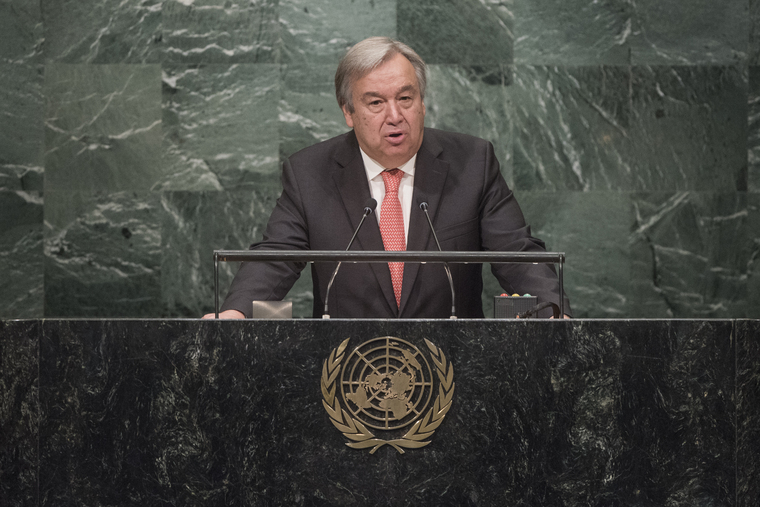
The United Nations Secretary General, António Guterres, has called on all parties to adhere to the reached agreement between Israel and Hamas on the first phase of a U.S.-backed Gaza peace plan.
“All hostages must be released in a dignified manner. A permanent ceasefire must be secured,” Guterres said in a statement on X on Thursday, urging an end to fighting and immediate, unhindered access for humanitarian aid into Gaza. “The suffering must end,” he added.
Guterres praised diplomatic efforts by the United States, Qatar, Egypt and Turkey, which helped broker the deal at talks in the Egyptian coastal resort of Sharm el-Sheikh.
The United Nations would support full implementation of the agreement, expand humanitarian aid and assist reconstruction efforts in Gaza, Guterres said.
The UN chief also encouraged both sides to seize this momentous opportunity to advance a two-state solution that would allow Israelis and Palestinians to live in peace and security. “The stakes have never been higher,” he said.
The two-state solution envisages an independent Palestinian state coexisting peacefully alongside Israel.
Both Israeli Prime Minister Benjamin Netanyahu and Hamas currently reject such an outcome. (Punch)
Madagascar’s President Andry Rajoelina on Monday appointed an army general as prime minister, hoping to quell surging protests against his leadership that have plunged the country into crisis.
In the latest in days of youth-led marches, security forces dispersed hundreds of demonstrators with tear gas in Madagascar’s capital, Antananarivo, injuring at least one, AFP reporters saw.
Sparked by anger against persistent water and power cuts in the impoverished Indian Ocean island, the demonstrations started on September 25 and have grown into an angry campaign for Rajoelina to resign.
“With wisdom, I have decided to appoint Ruphin Fortunat Dimbisoa Zafisambo, divisional general, as prime minister of the government,” Rajoelina said late Monday in a declaration at the presidential palace.
The new premier should “serve the people” and be “someone clean, with integrity, and who works quickly”, he said, promising he was “ready to save Madagascar”.
The Gen Z movement that rallied the protests on social media responded by repeating calls for Rajoelina to resign.
It said it was giving him a 48-hour “ultimatum” to “respond favourably” to their demands.
“As long as Andry Rajoelina remains in power, we will continue to fight,” the group said on social media.
Rajoelina’s move to sack his entire government last week failed to placate the demonstrators.
University students and residents gathered near the University of Ankatso on the outskirts of the capital on Monday, the 12th day of the movement.
They then marched towards the city centre, where they were stopped by a barricade put up by security forces.
Clashes erupted throughout the afternoon, with at least one young man wounded and evacuated to the main hospital, AFP reporters saw.
“There are about 120 hours of power cuts per week where I live,” said 21-year-old protester Tommy Fanomezantsoa.
“We are protesting for everyone’s sake,” he told AFP. “The president is not listening to the anger of the people at the bottom. He always does what he wants.”
The Ankatso district was the birthplace of a 1972 revolt that led to the ousting of the first president of the poverty-stricken island, Philibert Tsiranana.
“The future of this country depends on me, on you, on all of us,” one of the protest leaders told the crowd of several hundred people, urging them not to allow the movement to lose momentum.
“We can clearly see that democracy in Madagascar is not respected at all,” said another protest leader.
“They are even destroying it with brutality,” he said.
He was referring to a United Nations statement last week that at least 22 people had been killed in the protests and more than 100 wounded, a figure rejected by the authorities. (Punch)
France’s outgoing Prime Minister, Sébastien Lecornu, was due to start a last-ditch effort on Tuesday to rally cross-party support for a cabinet lineup that would pull his country out of a political deadlock.
President Emmanuel Macron tasked Lecornu, 39, with forming a government in early September after parliament toppled his predecessor over an unpopular austerity budget.
Lecornu unveiled a new cabinet on Sunday evening, but it immediately drew criticism for containing many of the same faces from the previous government, and Lecornu resigned on Monday morning.
But in a twist, Lecornu had by Monday evening accepted Macron’s request that he spend two days trying to salvage his administration.
Macron tasked Lecornu with “conducting final negotiations by Wednesday evening to define a platform of action and stability for the country,” a presidential official said, asking not to be named.
The president was ready to “assume his responsibilities” in case of failure, the official said, appearing to allude to his calling new legislative elections.
Lecornu was from 9:00 am (0700 GMT) to meet party leaders at the prime minister’s office in an attempt to breach the impasse.
A political crisis has rocked France for over a year, after Macron called snap polls in mid-2024, which ended in a hung parliament.
The chaos comes ahead of the 2027 presidential elections, expected to be a historic crossroads in French politics, with the French far right under Marine Le Pen sensing its best chance yet of taking power.
Edouard Philippe, a former premier and centre-right contender in the next presidential elections, on Tuesday slammed what he called a “distressing political game”.
He urged Macron to call early presidential elections as soon as the 2026 budget was approved.
Within Macron’s own ranks, Gabriel Attal — who was prime minister until last year and now leads the president’s centrist party — on Monday evening said he no longer understood Macron’s decisions.
After a succession of new premiers, it was “time to try something else”, he said.
Le Pen on Monday said it would be “wise” for Macron to resign but also urged snap legislative polls as “necessary”.
The party leader of Le Pen’s far-right National Rally (RN), Jordan Bardella, said it would be “ready to govern”.
Socialist party leader Olivier Faure late Monday called for “a change of course” with a “left-wing government”.
Bruno Retailleau, leader of the right-wing Republicans and outgoing interior minister, said he was not against remaining in a cabinet with Macron’s centrists as long as it did not mean fewer members from his party.
Lecornu’s two immediate predecessors, Francois Bayrou and Michel Barnier, were ousted by parliament in a standoff over an austerity budget.
Any next premier will still face the challenge of finding enough support for the spending bill in a chamber where the Macron-friendly bloc is in a minority.
The crisis comes as France’s public debt has reached a record high.
France’s debt-to-GDP ratio is now the European Union’s third-highest after Greece and Italy, and is close to twice the 60 percent permitted under EU rules.
Macron has so far resisted calls for fresh parliamentary polls and ruled out resigning before his mandate ends in 2027.He could also look for a new prime minister, who would be the eighth of the president’s mandate, but would face a struggle to survive without radical change. (Punch)
Japan’s ruling party picked hardline conservative Sanae Takaichi as its head on Saturday, putting her on course to become the country’s first female prime minister in a move set to jolt investors and neighbors.
The Liberal Democratic Party, which has ruled Japan for almost all of the postwar era, elected Takaichi, 64, to regain trust from a public angered by rising prices and drawn to opposition groups promising stimulus and clampdowns on migrants.
A vote in parliament to choose a replacement for outgoing Shigeru Ishiba is expected on October 15. Takaichi is favored as the ruling coalition has the largest number of seats.
Takaichi, the only woman among the five LDP candidates, beat a challenge from the more moderate Shinjiro Koizumi, 44, who was bidding to become the youngest modern leader.
Takaichi got 183 votes, while Koizumi garnered 156 in a runoff.
A former economic security and internal affairs minister with an expansionary fiscal agenda for the world’s fourth-largest economy, Takaichi takes over a party in crisis.
Various other parties, including the expansionist Democratic Party for the People and the anti-immigration Sanseito, have been steadily luring voters, especially younger ones, away from the LDP.
The LDP and its coalition partner lost their majorities in both houses under Ishiba over the past year, triggering his resignation.
“Recently, I have heard harsh voices from across the country saying we don’t know what the LDP stands for anymore,” Takaichi said in a speech before the second-round vote. “That sense of urgency drove me. I wanted to turn people’s anxieties about their daily lives and the future into hope.”
Takaichi, who says her hero is Margaret Thatcher, Britain’s first female prime minister, offers a starker vision for change than Koizumi and is potentially more disruptive.
An advocate of late premier Shinzo Abe’s “Abenomics” strategy to boost the economy with aggressive spending and easy monetary policy, she has previously criticized the Bank of Japan’s interest rate increases.
Such a spending shift could spook investors worried about one of the world’s biggest debt loads.
Naoya Hasegawa, chief bond strategist at Okasan Securities in Tokyo, said Takaichi’s election had weakened the chances of the BOJ raising rates this month, which markets had priced at around a 60% chance before the vote.
Takaichi has also raised the possibility of redoing an investment deal with U.S. President Donald Trump that lowered his punishing tariffs in return for Japanese taxpayer-backed investment.
The U.S. ambassador to Japan, George Glass, congratulated Takaichi, posting on X that he looked forward to strengthening the Japan-U.S. partnership “on every front”.
But her nationalistic positions – such as her regular visits to the Yasukuni shrine to Japan’s war dead, viewed by some Asian countries as a symbol of its past militarism – may rile neighbors like South Korea and China.
South Korea will seek to “cooperate to maintain the positive momentum in South Korea-Japan relations”, President Lee Jae Myung’s office said in a statement.
Takaichi also favors revising Japan’s pacifist postwar constitution and suggested this year that Japan could form a “quasi-security alliance” with Taiwan, the democratically governed island claimed by China.
Taiwan President Lai Ching-te welcomed her election, saying she was a “steadfast friend of Taiwan”.
“It is hoped that under the leadership of the new (LDP) President Takaichi, Taiwan and Japan can deepen their partnership in areas such as economic trade, security, and technological cooperation,” he said in a statement.
If elected prime minister, Takaichi said she would travel overseas more regularly than her predecessor to spread the word that “Japan is Back!”
“I have thrown away my own work-life balance and I will work, work, work,” Takaichi said in her victory speech.
Some of her supporters viewed her selection as a watershed in Japan’s male-dominated politics, though opinion polls suggest her socially conservative positions are favored more by men than women.
“The fact that a woman was chosen might be seen positively. I think it shows that Japan is truly starting to change and that message is getting across,” 30-year-old company worker Misato Kikuchi said outside Tokyo’s Shimbashi station.
Takaichi must also seek to blunt the rise of Sanseito, which broke into the political mainstream in a July election, appealing to conservative voters disillusioned with the LDP.
Echoing Sanseito’s warnings about foreigners, she kicked off her first official campaign speech with an anecdote about tourists reportedly kicking sacred deer in her hometown of Nara.
Takaichi, whose mother was a police officer, promised to clamp down on rule-breaking visitors and immigrants, who have come to Japan in record numbers in recent years.”We hope she will … steer Japanese politics in an ‘anti-globalism’ direction to protect national interests and help the people regain prosperity and hope,” Sanseito said in a statement. (JapanToday)
Police on Saturday were questioning six people arrested on suspicion of terror offenses after an attack on a synagogue in northwest England that left two men dead and Britain’s Jewish community shocked and grieving.
Jihad Al-Shamie, 35, was shot dead by police on Thursday outside the Heaton Park Congregation Synagogue in Manchester after he rammed a car into pedestrians, attacked them with a knife and tried to force his way into the building.
Three men and three women, aged between 18 and their 60s, were arrested in the greater Manchester area on suspicion of the “commission, preparation and instigation of acts of terrorism,” as police work to determine whether the attacker acted alone.
Congregation members Melvin Cravitz, 66, and Adrian Daulby, 53, died in the attack on Yom Kippur, the holiest day of the Jewish year. Police say Daulby was accidentally shot by an armed officer as he and other congregants barricaded the synagogue to block Al-Shamie from entering. Three other men are hospitalized with serious injuries.
Detectives say Al-Shamie, a British citizen of Syrian origin who lived in Manchester, may have been influenced by “extreme Islamist ideology.” He wore what appeared to be an explosives belt, which was found to be fake.
Police said Al-Shamie was out on bail over an alleged rape at the time of the attack but had not been charged.
The attack has devastated Britain’s Jewish community and intensified debate about the line between criticism of Israel and antisemitism.
Recorded antisemitic incidents in the U.K. have risen sharply since Hamas’ Oct. 7, 2023, attack on Israel and Israel’s ensuing war against Hamas in Gaza, according to Community Security Trust, a charity that provides advice and protection for British Jews.
Some politicians and religious leaders claimed pro-Palestinian demonstrations, which have been held regularly since the war in Gaza began, had played a role in spreading hatred of Jews. The protests have been overwhelmingly peaceful but some say chants such as “From the river to the sea, Palestine will be free” incite anti-Jewish hatred.
Israeli Prime Minister Benjamin Netanyahu and his supporters have frequently accused critics of Israel for its conduct of the war of antisemitism. Critics see it as an attempt to stifle even legitimate criticism.
Chief Rabbi Ephraim Mirvis, the head of Orthodox Judaism in Britain, said the attack was the result of “an unrelenting wave of Jew hatred” on the streets and online.
Some also say the U.K.’s recognition of a Palestinian state last month has emboldened antisemitism — a claim the government rejects. Deputy Prime Minister David Lammy was interrupted by boos and shouts of “Shame on you” on Friday as he addressed a vigil for victims of the attack in Manchester.
Police in London urged organizers to call off a protest planned for Saturday to oppose the banning of the group Palestine Action, which has been labeled a terrorist organization by the government.
Prime Minister Keir Starmer said protest organizers should “recognize and respect the grief of British Jews this week” and postpone the demonstration.
The group Defend Our Juries said it would not cancel the protest, where hundreds of people are expected to risk arrest by holding signs supporting the banned group.
Member Jonathon Porritt said protesters would “demonstrate huge respect and real grief for those affected by the absolute atrocity at Heaton Park.”
“But I don’t think that means that we should be asked to give up on our right to stand up for those who are being devastated by an ongoing, real-time genocide in Gaza,” he told the BBC. (CBS)
Hamas said on Friday it was ready to release hostages held in Gaza under a peace deal proposed by but wantDonald Trumped negotiations on the details and a say in the future of the Palestinian territory.
“The movement announces its approval for the release of all hostages — living and remains — according to the exchange formula included in President Trump’s proposal,” Hamas said in a statement, adding it was ready to enter talks “to discuss the details”.
The peace plan for Gaza, presented by Trump this week and backed by Israeli Prime Minister Benjamin Netanyahu, calls for a ceasefire, the release of hostages within 72 hours, Hamas’s disarmament and a gradual Israeli withdrawal from Gaza.
In the statement, Hamas said it agreed to hand over power in Gaza to a body of Palestinian technocrats but said decisions on the territory’s long-term future would need to be discussed within a Palestinian framework “in which Hamas will participate and contribute responsibly”.
Hamas’s statement made no mention of its intentions on disarmament, a key part of the US president’s plan and a move the group has previously resisted.
Following the announcement, Mahmoud Mardawi, a senior Hamas official, told AFP the group welcomed Trump’s proposal, but that “without clear terms, criteria, and transparency, we need clarification and confirmation through a negotiated agreement”.
“The American proposal is vague, ambiguous, and lacks clarity,” Mardawi said.
Hamas had “made our position clear, and we are now waiting to see how the details of the terms will be implemented and clarified”, he added.
Under the US plan published on Monday — which has been welcomed by world powers, including Arab and Muslim nations — a post-war transitional authority for Gaza would be headed by Trump himself.
Earlier on Friday the US president gave Hamas until Sunday night to respond to the plan, and warned the group it faced “all hell” if it did not agree to the terms. (Vanguard)
The death toll from a powerful earthquake in the central Philippines rose to 72 on Thursday, rescuers said, as officials turned their efforts to the hundreds injured and thousands left homeless.
Firefighters and rescuers pulled a woman and her child from the rubble of a collapsed hotel overnight Wednesday in the city of Bogo, near the epicenter of the 6.9-magnitude quake that struck on Tuesday.
The body of another woman was also retrieved from the site earlier in the day, AFP journalists saw.
The national government said 294 people were injured and around 20,000 had fled their homes. Nearly 600 houses were wrecked across the north of Cebu island and many are sleeping on the streets as hundreds of aftershocks shake the area.
Cebu provincial governor Pamela Baricuatro made several urgent appeals for help on Thursday, saying thousands needed safe drinking water, food, clothes and temporary housing, as well as volunteers to sort and distribute aid.
“Many homes were destroyed and many families are in need of help to recover… They need our help, prayers and support,” she said on Facebook.
President Ferdinand Marcos flew to Cebu with senior aides on Thursday to inspect the damage and coordinate relief efforts. He did not immediately speak to the press.
A tiny village chapel is serving as a post-quake home for 18-year-old Bogo resident Diane Madrigal and 14 of her neighbors after their houses were destroyed. Their clothes and food are scattered across the chapel’s pews.
“The entire wall (of my house) fell so I really don’t know how and when we can go back again,” Madrigal told AFP. “I am still scared of the aftershocks up to now, it feels like we have to run again.”
Mother-of-four Lucille Ipil, 43, added her water container to a 10-meter line of them along a road in Bogo, where residents desperately waited for a fire truck scheduled to bring them water.
“The earthquake really ruined our lives. Water is important for everyone. We cannot eat, drink or bathe properly,” she told AFP. “We really want to go back to our old life before the quake but we don’t know when that will happen… Rebuilding takes a long time.”
Many areas remain without electricity, and dozens of patients were sheltering in tents outside the damaged Cebu provincial hospital in Bogo.
“I’d rather stay here under this tent. At least I can be treated,” 22-year-old Kyle Malait told AFP as she waited for her dislocated arm to be treated.
More than 110,000 people in 42 communities affected by the quake will need assistance to rebuild their homes and restore their livelihoods, according to the regional civil defense office.
Search and rescue efforts appeared to be winding down in Bogo early Thursday, as rescuers milled around awaiting instructions.
“As of now, all those who were reported missing were already retrieved,” Cebu fire bureau official Liewellyn Lee Quino told AFP.
Rescuers were sent to re-check a collapsed hotel hours after three bodies were retrieved.
“The final check is important so that we can assure the community here that no one is forgotten inside these establishments, and that they can choose to destroy this place completely (for redevelopment),” Quino said.
Earthquakes are a near-daily occurrence in the Philippines, which is situated on the Pacific “Ring of Fire”, an arc of intense seismic activity stretching from Japan through Southeast Asia and across the Pacific basin.Most are too weak to be felt by humans but strong and destructive quakes come at random, with no technology available to predict when and where they might strike. (JapanToday)
Scientist and global activist Jane Goodall, who turned her childhood love of primates into a lifelong quest for protecting the environment, has died at the age of 91, the institute she founded said on Wednesday.
Goodall died of natural causes while in California on a speaking tour, the Jane Goodall Institute said in a social media post.
“Dr. Goodall’s discoveries as an ethologist revolutionized science, and she was a tireless advocate for the protection and restoration of our natural world,” it said on Instagram.
The primatologist-turned-conservationist spun her love of wildlife into a life-long campaign that took her from a seaside English village to Africa and then across the globe in a quest to better understand chimpanzees, as well as the role that humans play in safeguarding their habitat and the planet’s health overall.
Goodall was a pioneer in her field, both as a female scientist in the 1960s and for her work studying the behavior of primates. She created a path for a string of other women to follow suit, including the late Dian Fossey.
She also drew the public into the wild, partnering with the National Geographic Society to bring her beloved chimps into their lives through film, TV and magazines.
She upended scientific norms of the time, giving chimpanzees names instead of numbers, observing their distinct personalities, and incorporating their family relationships and emotions into her work. She also found that, like humans, they use tools.
“We have found that after all there isn’t a sharp line dividing humans from the rest of the animal kingdom,” she said in a 2002 TED Talk.
As her career evolved, she shifted her focus from primatology to climate advocacy after witnessing widespread habitat devastation, urging the world to take quick and urgent action on climate change.
“We’re forgetting that we’re part of the natural world,” she told CNN in 2020. “There’s still a window of time.”
In 2003, she was appointed a Dame of the British Empire and, in 2025, she received the U.S. Presidential Medal of Freedom.
Born in London in 1934 and then growing up in Bournemouth on England’s south coast, Goodall had long dreamed of living among wild animals. She said her passion for animals, stoked by the gift of a stuffed toy gorilla from her father, grew as she immersed herself in books such as “Tarzan” and “Dr. Dolittle.”
She set her dreams aside after leaving school, unable to afford university. She worked as a secretary and then for a film company until a friend’s invitation to visit Kenya put the jungle – and its inhabitants – within reach.
After saving up money for the journey by boat, Goodall arrived in the East African nation in 1957. There, an encounter with famed anthropologist and paleontologist Dr. Louis Leakey and his wife, archaeologist Mary Leakey, set her on course to work with primates.
Under Leakey, Goodall set up the Gombe Stream Chimpanzee Reserve, later renamed the Gombe Stream Research Centre, near Lake Tanganyika in present-day Tanzania. There she discovered chimpanzees ate meat, fought fierce wars, and perhaps most importantly, fashioned tools in order to eat termites.
“Now we must redefine tools, redefine man, or accept chimpanzees as humans,” Leakey said of the discovery.
Although she eventually paused her research to earn a PhD at Cambridge University, Goodall remained in the jungle for years. Her first husband and frequent collaborator was wildlife cameraman Hugo van Lawick.
Through the National Geographic’s coverage, the chimpanzees at Gombe Stream soon became household names – most famously, one Goodall called David Greybeard for his silver streak of hair.
Nearly thirty years after first arriving in Africa, however, Goodall said she realized she could not support or protect the chimpanzees without addressing the dire disappearance of their habitat. She said she realized she would have to look beyond Gombe, leave the jungle, and take up a larger global role as a conservationist.
In 1977, she set up the Jane Goodall Institute, a nonprofit organization aimed at supporting the research in Gombe as well as conservation and development efforts across Africa. Its work has since expanded worldwide and includes efforts to tackle environmental education, health and advocacy.
She made a new name for herself, traveling an average of 300 days a year to meet with local officials in countries around the world and speaking with community and school groups. She continued touring to the end of her life, speaking at Climate Week in New York City just last week.
She later expanded the institute to include Roots & Shoots, a conservation program aimed at children.
It was a stark shift from her isolated research, spending long days watching chimpanzees.
“It never ceases to amaze me that there’s this person who travels around and does all these things,” she told the New York Times during a 2014 trip to Burundi and back to Gombe. “And it’s me. It doesn’t seem like me at all.”
A prolific author, she published more than 30 books with her observations, including her 1999 bestseller “Reason For Hope: A Spiritual Journey,” as well as a dozen aimed at children.
Goodall said she never doubted the planet’s resilience or human ability to overcome environmental challenges.
“Yes, there is hope … It’s in our hands, it’s in your hands and my hands and those of our children. It’s really up to us,” she said in 2002, urging people to “leave the lightest possible ecological footprints.”
She had one son, known as ‘Grub,’ with van Lawick, whom she divorced in 1974. Van Lawick died in 2002. In 1975, she married Derek Bryceson. He died in 1980. (JapanToday)
President Donald Trump’s administration on Wednesday froze $26 billion for Democratic-leaning states, following through on a threat to use the government shutdown to target Democratic priorities.
The targeted programs included $18 billion for transit projects in New York, home to Congress’s top two Democrats, and $8 billion for green-energy projects in 16 Democratic-run states, including California and Illinois. Vice President JD Vance, meanwhile, warned that the administration might extend its purge of federal workers if the shutdown lasts more than a few days.
The moves made clear that Trump would carry out his threat to take advantage of the shutdown to punish his political opponents and extend his control over the $7 trillion federal budget, established by the U.S. Constitution as the domain of Congress.
The pressure tactics came as the 15th government shutdown since 1981 suspended scientific research, financial oversight, environmental cleanup efforts and a wide range of other activities.
Some 750,000 federal workers were ordered not to work, while others, such as troops and Border Patrol agents, began to work without pay. The Department of Veterans Affairs said it would provide burials at national cemeteries, but would not erect headstones or mow the grass.
Vance said at a White House briefing that the administration would be forced to resort to layoffs if the shutdown lasts more than a few days, adding to the 300,000 who will be pushed out by December. Previous shutdowns have not resulted in permanent layoffs.
The U.S. Patent and Trademark Office said it would lay off 1% of its 14,000 employees, according to an internal letter seen by Reuters.
Hakeem Jeffries, the top Democrat in the House of Representatives, said the funding freeze for subway and harbor projects in his home of New York would throw thousands out of work.
Top Senate Democrat Chuck Schumer, also from New York, said Trump was targeting regular Americans for partisan aims.
“He is using the American people as pawns, threatening pain on the country as blackmail,” Schumer said.
Republican Senator Thom Tillis said he was concerned that the freezing of infrastructure funds for New York could make it harder for Congress to exit the shutdown.
“They need to be really careful with that, because they can create a toxic environment here,” Tillis said. “So hopefully they’re working with the leader, and the leader with them, on not creating more work to get us out of this posture.”
Republican Senate Leader John Thune dismissed concerns that the spending freeze amounted to hostage-taking.
“Well, vote to open up the government and that issue goes away, right? I mean, it’s pretty straightforward,” he said at a press conference.
Meanwhile, the Senate again rejected efforts to keep the government functioning as both a Republican proposal that would fund the government through November 21 and a Democratic vote that would pair funding with additional health benefits failed in floor votes.
Trump’s Republicans hold a 53-47 Senate majority, but they need the support of at least seven of Schumer’s Democrats to meet the chamber’s 60-vote threshold for spending bills.
At issue on the government funding front is $1.7 trillion for agency operations, which amounts to roughly one-quarter of annual spending. Much of the remainder goes to health and retirement programs and interest payments on the growing $37.5 trillion debt.
A bipartisan group of senators huddled on the floor during the vote, trying to find a path forward.
“I want to see that a deal is a deal, and I would like to see the Republicans make a commitment to work with us on health care,” said Senator Tim Kaine, a Virginia Democrat who represents many federal workers near the nation’s capital. “But I’ve never said that has to be all I’s dotted and T’s crossed because that could be complicated.”
Democrats are also seeking guarantees that Trump will not be able to ignore spending bills he signs into law, as he has repeatedly done since returning to office.
Both sides sought to pin the blame on the other, looking for advantage ahead of the 2026 midterm elections that will determine control of Congress.
Democrats said Republicans were responsible for the disruption, as they control the levers of power in Washington.
Republicans said Democrats were surrendering to partisan pressures to oppose Trump, even though they have routinely backed spending bills in the past. They also repeated a false claim that the Democratic proposal would extend health coverage to people who are in the country illegally. According to the nonpartisan Congressional Budget Office, the Democratic plan would only restore coverage to certain categories of immigrants who are in the country legally, such as asylum seekers and people on work visas.
Several government agencies posted notices on their websites blaming the “radical left” for the shutdown – a possible violation of a law known as the Hatch Act meant to insulate nuts-and-bolts government services from partisan politics.
The longest U.S. government shutdown, which stretched over 35 days in 2018-2019 during Trump’s first term, ended in part after flight delays caused by air traffic controllers calling in sick. (JapanToday)