
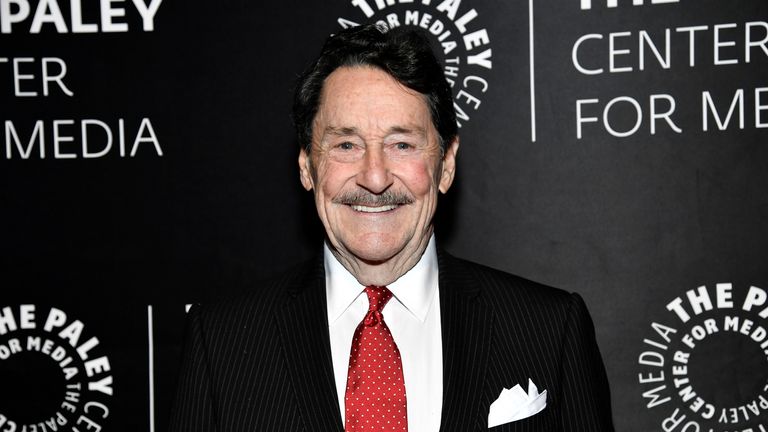
Peter Cullen, the actor behind the voice of characters including Eeyore in Disney’s Winnie the Pooh franchise and Optimus Prime in Transformers, has died aged 85.
He died on Wednesday at his home in Los Angeles, a statement said.
The Canadian actor began his biggest role – as Optimus Prime, the honourable leader of the Autobots – for the Transformers TV series in 1984. He returned for seven Hollywood Transformers films from 2007 to 2023 and other spinoffs.
Cullen voiced the melancholic donkey Eeyore in The New Adventures of Winnie the Pooh TV series from the late 1980s as well as numerous related shows, films and games.
His other notable roles included the roars of King Kong for the 1976 remake, and KARR – Knight Automated Roving Robot, the evil counterpart to KITT – in the Knight Rider series in 1982 and 2009.
The actor is also credited with coming up with the eerie clicking sounds that emerged from the mouth of the monster in the Arnold Schwarzenegger film Predator in 1987.
His family said: “Peter Cullen passed away peacefully, surrounded by his loving family – and held in the hearts of his many friends and countless fans worldwide.
“His family asks that you honour his remarkable legacy by serving your communities and leading others with compassion, integrity, and loyalty and always remember, ‘be strong enough to be gentle’.”
The Montreal-born actor began his career on Canadian TV and radio and was then a regular on programmes including The Sonny & Cher Show and The Smothers Brothers Comedy Hour before deciding to concentrate on voice acting.
Cullen said Optimus Prime’s resonant and authoritative voice was inspired by his older brother Larry, a retired captain in the US Marine Corps who had served in the Vietnam war, who suggested he should play the character as “a real hero, don’t be a Hollywood hero”.
“He said, ‘Don’t go yelling and screaming. He’s strong enough to be gentle’,” Cullen recalled. “And that resonated with me, and I could hear his voice all the way to the audition. When he drops down, when he gets serious, is where I found Optimus Prime.”
Cullen gave Larry a cut of the wages he received for playing Optimus Prime until his brother’s death in 2011.
In a 2014 NPR interview, Cullen acknowledged that he initially approached playing Optimus Prime with puzzlement. “I auditioned like everybody else,” he said. “I was told it was a hero, and I was told it was a truck.”
The actor’s performance earned him a Daytime Emmy nomination for outstanding performer in an animated programme in 2011, and he was honoured with a lifetime achievement award at the Children’s & Family Emmy Awards in 2023.
When the director Michael Bay resurrected the Transformers franchise for a film in 2007 starring Shia LaBeouf, Cullen told IGN: “I describe it as kind of slipping into an old pair of very comfortable shoes that you haven’t worn for a while. I just slipped right into them, and they felt as good as the last time I put them on.” (Guardian)





 English