
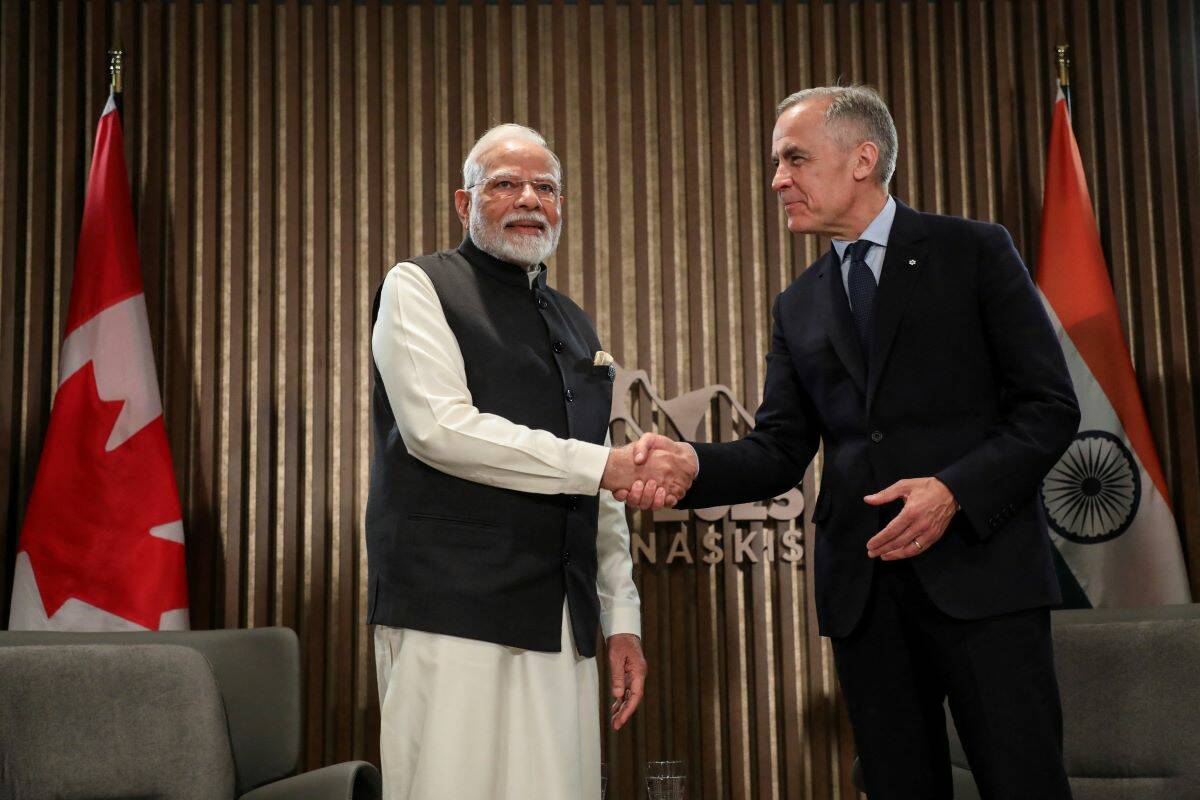
India and Canada have announced a host of agreements, including a 10-year nuclear energy deal, after their prime ministers met in Delhi to reset ties that plummeted due to diplomatic tensions.
Narendra Modi and Mark Carney also struck agreement in areas such as technology, critical minerals, space, defence and education.
Carney said they agreed to conclude a free trade deal, years in the making, by the end of 2026. Both countries want to reduce exposure to punitive US trade tariffs.
Under Carney, the two governments are trying to repair ties that were strained when his predecessor accused Delhi of a link to the 2023 assassination of Sikh separatist Hardeep Singh Nijjar on Canadian soil.
India vociferously rejected the allegation by Justin Trudeau.
Trade and diplomatic relations almost came to a standstill as both sides expelled each other’s diplomats and cancelled visa services. Canada hosts a huge expatriate Indian community.
But since Carney took office last year, the relationship has been cautiously rebuilt —helped by the fact that his government has said it believes India is not currently linked to violent crimes or threats on Canadian soil.
Some in Canada have countered that claim, however, including a Liberal MP from Carney’s own party and members of the Sikh diaspora in Canada, who say they believe they continue to be targeted by India.
Canada’s spy agency listed India late last year as one of the countries carrying out espionage and foreign interference in the country, along with Russia, China and Iran.
In a statement on Monday, the Canadian Security Intelligence Service said its “threat assessment of the main perpetrators of foreign interference and espionage against Canada has not changed”.
Canada’s foreign minister Anita Anand has distanced herself from comments made by a senior Canadian official saying that India had ceased all foreign interference in Canada.
“The words of the senior official are not words that I personally would use,” she told reporters in Delhi after Carney’s meeting with Modi on Monday.
But Anand defended Canada’s decision to re-engage with India, saying “we need to have these diplomatic conversations in order to make progress”.
Carney has not yet spoken to Canadian reporters since his trip began. His office cancelled a planned news conference following the meeting with Modi, citing his tight schedule.
The case of four men charged over Nijjar’s killing is still before the courts.
At talks in Delhi, both Carney and Modi underscored India and Canada’s long-standing relationship, mutual goals and close people-to-people ties.
“In civil nuclear energy, we have reached a landmark deal for long-term uranium supply. We will also work together on small modular reactors and advanced reactors,” Modi told reporters after their meeting at Hyderabad House in Delhi.
He described the two countries as “natural partners in technology and innovation” and said they would enhance co-operation in AI, supercomputing and semiconductors, as well as jointly host a renewable energy summit.
Carney said Canada was well positioned to contribute to energy-hungry India’s nuclear fuel needs and added that the two countries were launching a strategic energy partnership.
He hailed the progress made in rebuilding relations.
“There has been more engagement between the Canadian and Indian governments in the last year than there has been in more than two decades combined,” he said.
On trade, Modi said: “Our target is to reach $50bn in bilateral trade. This is why we have decided to finalise a comprehensive economic partnership soon.”
Carney said he wanted to reach a deal on the “ambitious agreement” by the end of the year. It’s been discussed on-and-off for the past 15 years so concluding it would be a significant achievement.
Analysts say that Carney’s decision to put diplomatic tensions behind him and extend an olive branch to India is a pragmatic one, based on present day geopolitical shifts.
The same holds true for India, which is looking to forge new trade partnerships to diversify its imports and also reduce its reliance on Russia for its energy needs.
Surveys suggest a majority of the Canadian public support re-engaging with India. One recent poll conducted by Angus Reid found that half believe it is the “right time” to restore ties.
The poll also suggests that more Canadians have a favourable view of India (30%) than of the US (26%), as Canada continues to be squeezed by tariffs imposed by the Trump administration.
Earlier on Monday, Carney met India’s Foreign Minister S Jaishankar where the two discussed charting a “forward-looking partnership”.
Carney’s four-day trip began with a visit to the financial capital, Mumbai, where he met business leaders and ministers on 28 February with a view to boost trade and investment in India.
After concluding his trip in Delhi, Carney is set to travel to Australia and then Japan as part of his strategy to diversify Canada’s trade and invite new investments. (BBC)

 English