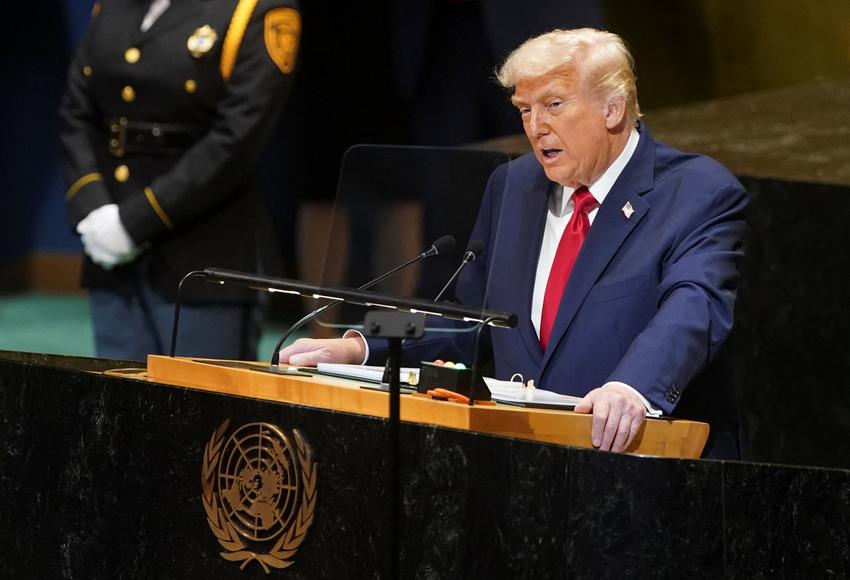
US President Donald Trump on Saturday urged other nations to send ships to help secure the Strait of Hormuz, the critical chokepoint for global oil supplies disrupted by the Mideast war.
Trump, who has said the United States will soon start escorting tankers through the strait, posted on Truth Social that “Many countries, especially those who are affected by Iran’s attempted closure of the Hormuz Strait, will be sending War Ships, in conjunction with the United States of America, to keep the Strait open and safe.”
The US president added: “Hopefully China, France, Japan, South Korea, the UK, and others, that are affected by this artificial constraint, will send Ships to the area.”
Iranian strikes have all but halted maritime traffic in the strait, through which a fifth of global crude oil and liquefied natural gas normally pass. It is just 54 kilometers (34 miles) wide at its narrowest point.
With oil prices spiking, Trump was asked Friday when the US Navy would begin escorting tankers through the Strait of Hormuz. “It’ll happen soon, very soon,” he said.
In his post on Saturday, Trump asserted that Iran’s military capability had been eliminated but he conceded that it was still able to attack the strait.
“We have already destroyed 100% of Iran’s Military capability, but it’s easy for them to send a drone or two, drop a mine, or deliver a close range missile somewhere along, or in, this Waterway, no matter how badly defeated they are,” he wrote.
As he urged nations to send ships to the strait, he added that “the United States will be bombing the hell out of the shoreline, and continually shooting Iranian Boats and Ships out of the water. One way or the other, we will soon get the Hormuz Strait OPEN, SAFE, and FREE!” (Channels)
Nigeria’s senior women’s basketball team, D’Tigress, opened their campaign at the FIBA Women’s Basketball World Cup Qualifying Tournament with a commanding 33-point victory over Colombia.
The News Agency of Nigeria reports that D’Tigress defeated Colombia 70–37 on Wednesday to secure their first win of the tournament, currently taking place in France.
Nigeria led 18–12 in the opening quarter with impressive displays, but Colombia responded strongly to edge the second quarter 17–16.
D’Tigress dominated the second half, outscoring Colombia 19–5 in the third quarter and 17–3 in the fourth to seal an emphatic victory.
The win marked Head Coach Rena Wakama’s 14th victory since her appointment in 2023.
Since taking charge, Wakama has overseen 18 competitive matches, winning 14 and losing four.
Her achievements include guiding Nigeria to the 2023 and 2025 FIBA Women’s Afrobasket championship titles.
D’Tigress currently rank eighth in the FIBA world rankings, reflecting consistent progress and strong performances in recent international competitions.
One of their most notable achievements remains reaching the quarter-finals of the FIBA Women’s Basketball World Cup.
Technically, the result again highlighted the growing gap between Nigeria and several emerging basketball nations.
Nigeria controlled the tempo, defended aggressively and converted transition opportunities efficiently throughout the game.
Victoria Macaulay led the scoring with 13 points, delivering the performance in 14 minutes and 20 seconds on the court.
Ifunaya Okoro also finished in double figures, contributing 10 points after playing 28 minutes and one second.
Nigeria will face South Korea in their next group match scheduled for Thursday. (Punch)
Eleven suspects, including a parliamentary aide to France’s hard-left party, have been arrested in connection with the killing last week of a far-right activist in an incident that has shocked the country and laid bare its deep political divisions.
Quentin Deranque, 23, died on Saturday after sustaining a severe brain injury. The Lyon prosecutor, Thierry Dran, said he had been “thrown to the ground and beaten by at least six individuals” during an incident last week.
The attack took place as Deranque, a mathematics student, was on the sidelines of a protest against a university conference attended by Rima Hassan, a European member of parliament for Jean-Luc Mélenchon’s leftwing party, La France Insoumise (LFI).
The anti-immigration Némésis collective, which was protesting against the conference, said at the weekend that Deranque had been there to protect its members and was assaulted by anti-fascist activists. Hassan and other members of LFI have condemned the killing.
The incident has inflamed political tensions in France in the run-up to next month’s municipal elections as well as the 2027 presidential race, in which polls suggest the far-right National Rally (RN) could achieve its best result to date.
The first wave of arrests was announced late on Tuesday, as Dran said nine suspects had been arrested. Those detained included people who were suspected of having participated in the violence and others who had provided support to them, sources told Agence France-Presse.
Hours later, two more suspects were arrested: a man who the prosecutor said was suspected of being directly linked to the violence as well as his partner, who was suspected of trying to help him evade justice.
The LFI politician Raphaël Arnault confirmed that his parliamentary assistant was among those detained, adding the aide had “ceased all parliamentary work”.
On Wednesday, as news of the arrests spread, the LFI said it had been forced to evacuate its national headquarters. “The national headquarters of LFI have just been evacuated following a bomb threat,” the party’s coordinator, Manuel Bompard, said on social media. “Police services are on site. All employees and activists are safe.”
As videos of last week’s deadly confrontation continued to circulate on social media, Mélenchon called for calm. “Let’s not fuel the incitement to take the law into one’s own hands,” the LFI leader said on social media.
Images broadcast by TF1 of the alleged attack showed several people hitting three others who were lying on the ground, two of whom managed to escape. One witness told AFP: “People were hitting each other with iron bars.”
Némésis, the anti-immigration collective linked to Deranque, has blamed the killing on La Jeune Garde (Young Guard), an anti-fascist youth group co-founded by Arnault before he was elected to parliament. La Jeune Garde – which was dissolved in June – has denied any links to the “tragic events” and Arnault has called the killing “horrific”.
While the government has singled out LFI and La Jeune Garde, the Lyon prosecutor on Monday declined to comment on those claims, instead telling reporters that the investigation was looking into suspected “intentional homicide” and aggravated assault.
Politicians held a minute of silence on Tuesday afternoon at France’s national assembly in memory of Deranque, while a march is expected to be held in Lyon next Saturday in his honour.
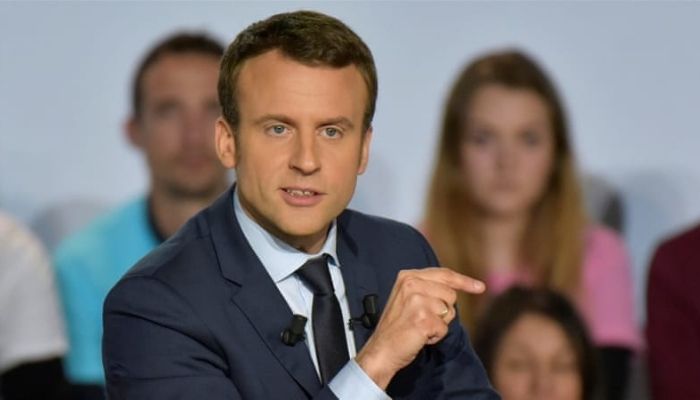
In a post this weekend, the French president, Emmanuel Macron, addressed the incident and called for calm. “It is essential that the perpetrators of this ignominy be prosecuted, brought to justice and convicted. Hatred that kills has no place among us,” he wrote on social media. “I call for calm, restraint and respect.” (Guardian)
Major European Union states including Germany and France decried U.S. President Donald Trump’s tariff threats over Greenland as blackmail on Sunday, as France proposed responding with a range of untested economic countermeasures.
Trump vowed on Saturday to implement a wave of increasing tariffs on EU members Denmark, Sweden, France, Germany, the Netherlands and Finland, along with Britain and Norway, until the U.S. is allowed to buy Greenland.
All eight countries, already subject to U.S. tariffs of 10% and 15%, have sent small numbers of military personnel to Denmark’s vast Arctic island, as a row with the United States over its future escalates.
“Tariff threats undermine transatlantic relations and risk a dangerous downward spiral,” they said in a joint statement.
The Danish exercise in Greenland was designed to strengthen Arctic security and posed no threat to anyone, they said, adding that they were ready to engage in dialogue, based on principles of sovereignty and territorial integrity.
Danish Prime Minister Mette Frederiksen said in a statement she was pleased with the consistent messages from other states, adding: “Europe will not be blackmailed”, a view echoed by Germany’s finance minister and Sweden’s prime minister.
“It’s blackmail what he’s doing,” Dutch Foreign Minister David van Weel said on Dutch television of Trump’s threat.
Cyprus, holder of the rotating six-month EU presidency, summoned ambassadors to an emergency meeting in Brussels late on Sunday as EU leaders stepped up contacts.
Danish Foreign Minister Lars Lokke Rasmussen, visiting his Norwegian counterpart in Oslo, said Denmark would continue to focus on diplomacy, referring to an agreement Denmark, Greenland and the U.S. made on Wednesday to set up a working group.
“Even though we are now being confronted with these threats, we will naturally try to stay on that path,” Rasmussen said.
“The U.S. is also more than the U.S. president. I’ve just been there. There are also checks and balances in American society.” he added.
Meanwhile, a source close to Emmanuel Macron said the French President was pushing to activate the Anti-Coercion Instrument, which could limit access to public tenders, investments or banking activity or restrict trade in services, in which the U.S. has a surplus with the bloc, including digital services.
Irish Prime Minister Micheal Martin said that while there should be no doubt the EU would retaliate, it was “a bit premature” to activate the instrument.
And Italian Prime Minister Giorgia Meloni, who is closer to the U.S. President than some other EU leaders, described the tariff threat on Sunday as “a mistake”, adding she had spoken to Trump a few hours earlier and told him what she thought.
“He seemed interesting in listening,” she told a briefing with reporters during a trip to Korea.
British Culture Secretary Lisa Nandy said allies needed to work with the United States to resolve the dispute.
“Our position on Greenland is non-negotiable … It is in our collective interest to work together and not to start a war of words,” she told Sky News.
The U.S. tariff threats call into question trade deals struck with Britain in May and the EU in July.
The limited agreements have already faced criticism about their lopsided nature, with the U.S. maintaining broad tariffs, while their partners are required to remove import duties.
The European Parliament looks likely now to suspend its work on the EU-U.S. trade deal. It had been due to vote on removing many EU import duties on January 26-27, but Manfred Weber, head of the European People’s Party, the largest group in parliament, said late on Saturday that approval was not possible for now.
German Christian Democrat lawmaker Juergen Hardt also mooted what he told Bild newspaper could be a last resort “to bring President Trump to his senses on the Greenland issue”, a boycott of the soccer World Cup that the U.S. is hosting this year. (JapanToday)
Should foreign tourists pay more for state-funded galleries than locals, or should art be accessible to all, without discrimination? France is hiking prices for non-Europeans at the Louvre this week, provoking debate about so-called “dual pricing”.
From Wednesday, any adult visitor from outside the European Union, Iceland, Liechtenstein and Norway will have to pay 32 euros ($37) to enter the Louvre — a 45-percent increase — while the Palace of Versailles will up its prices by three euros.
Americans, UK citizens and Chinese nationals, who are some of the museum’s most numerous foreign visitors, will be among those affected, as will tourists from poorer countries.
The French move has few precedents elsewhere in Europe, but is more common in developing countries, where tariffs at sites such as Machu Picchu in Peru or the Taj Mahal in India vary.
Trade unions at the Louvre have denounced the policy as “shocking philosophically, socially and on a human level” and have called for strike action over the change, along with a raft of other complaints.
They argue that the museum’s vast collection of 500,000 items, including many from Egypt, the Middle East or Africa, hold universal human value.
While rejecting discriminatory pricing on principle, they are also worried for practical reasons, as staff will now need to check visitors’ identity papers.
French academic Patrick Poncet has drawn a parallel between France’s move and the policies of U.S. President Donald Trump, whose administration hiked the cost for foreign tourists of visiting U.S. National Parks by $100 on January 1.
The French policy was “symptomatic of the return, as elsewhere in the world, of unabashed nationalism”, Poncet wrote in Le Monde newspaper last month.
Other state-owned French tourist hotspots are also hiking their fees, including the Chambord Palace in the Loire region and the national opera house in Paris.
The government has justified the increases on financial grounds, looking to raise 20-30 million euros annually at a time when it is under pressure to boost revenues and cut spending.
Some of the funds will go towards a colossal plan to renovate the Louvre, which French President Emmanuel Macron announced last year.
Estimated to cost around a billion euros, unions and some art critics have called the project wasteful.
Everyone agrees the Louvre is in poor shape, however, with a recent water leak, structural problems and an embarrassing daylight robbery in October focusing minds.
“I want visitors from outside the EU to pay more for their entry tickets and for that surcharge to go toward funding the renovation of our national heritage,” Culture Minister Rachida Dati said at the end of 2024 as she announced the hikes.
“The French are not meant to pay for everything all by themselves,” she added.
It remains to be seen whether the break with European convention by the continent’s most-visited country will spur other cultural destinations to follow suit.
Pricing based on age is commonplace in Europe, with access for under-18s free at places such as the Acropolis in Athens, the Prado in Madrid or the Colosseum in Rome to encourage them to visit.
The Louvre will remain free for minors from all countries and Europeans under 26.
Other destinations, such as the Doge’s Palace in Venice, offer free entrance for city residents.
Britain has long had a policy of offering universal free access to permanent collections at its national galleries and museums.
But the former director of the British Museum, Mark Jones, backed fee-paying in one of his last interviews in charge, telling The Sunday Times newspaper in 2024 that “it would make sense for us to charge overseas visitors for admission”.
The proposal prompted debate but has not been adopted.
A research paper published last year by The Cultural Policy Unit, a British museum think tank, opposed it for both practical and philosophical reasons.
It would reduce entries, lengthen queue times and overturn a centuries-old policy, the report concluded.
“Britain holds its national collections for the world — not just its own residents,” it objected. (JapanToday)
New Chelsea boss Liam Rosenior has been convicted of speeding after fog delayed his flight back to the UK, where he was due to complete a speed awareness course.
Rosenior admitted being behind the wheel of the vehicle, which had been travelling at 36mph in a 30mph zone in Rykneld Road, Littleover, Derbyshire, at 11.41am on 7 July.
He was offered the chance to avoid a criminal prosecution by completing a speed awareness course, but did not turn up to the session, which had been arranged.
Rosenior explained, in a note to Derby Magistrates’ Court he “had to stay another night and be on a plane the next day during the time of the course”.
He added: “Unfortunately, the course could not be fulfilled due to unforeseen circumstances. Understandably, due to circumstances, I have to accept the situation as is.”
Rosenior was convicted at a single justice procedure hearing on 2 January, with a magistrate ordering him to pay out a total of £1,052 in fines, costs, and court fees.
The former Strasbourg boss was appointed as head coach on Tuesday following Enzo Maresca’s exit.
London-born Rosenior, 41, has admitted his new position at the Premier Leagueclub represents a significant step up from his previous job in France.
“The reality is Strasbourg is not on the level as Chelsea,” he said at press conference at the French club – also owned by Chelsea’s parent company BlueCo.
“There are certain clubs you just cannot just turn down. I hope the [Strasbourg] fans can see that.”
Rosenior, who played in England for 16 years, began his managerial career at Derby County – where he got the top job on an interim basis.
His first permanent position was at Hull City, where he lasted for 18 months and took the Championship to the brink of the play-offs before being sacked by the owner who said the pair had a difference in footballing philosophy.
Rosenior, who has been given a six-and-a-half year contract at Chelsea, said on Tuesday that managing a “world-class” club was “something I have always dreamed of”.
“I am looking forward to the challenge,” he said. “If I didn’t think I was ready, I wouldn’t have accepted it.
Chelsea said that the club’s new head coach had “signed a contract with the club that will take him through to 2032”.
Rosenior becomes Chelsea’s fourth permanent boss since owners BlueCo took control in 2022.
Maresca was dismissed on New Year’s Day, leaving abruptly following a deterioration in his relationship with bosses.
It also followed a disappointing run of results – one win from the last seven Premier League games – that left the club 15 points adrift of leaders Arsenal.
Maresca is understood to have stepped down because he felt his position was untenable, while Chelsea were already considering sacking the head coach due to poor results, his comments in the media, disagreements with the medical team and reports linking him with other clubs. (SkyNews)
Black Bazaar is a novel that touches the issues faced by African immigrants in France who are facing poverty, racism, migration and so on. Originally published in French in 2009 (translated into English in 2012 by Sarah Ardizzone), The novel is set in France, but there is a mention of two Congos (Kinshasha and Brazzaville) with the protagonist who we don’t know his real name but is nicknamed Buttologist.
Buttologist is the protagonist and he narrates the entire story. He is both kind and patient, sometimes he gets angry. He has spoken of his travails in a country (France) which colonized his mother country, Congo Brazzaville after leaving the military. He also narrates about his childhood (in the Congo), his parents especially his father (who he calls old man) and it is filled with nostalgia. He is an aspiring writer who confides with Jean Phillipe, another character in the book from Haiti who advises him to write about his travails in a journal titled Black Bazaar.
The reason he is called Buttologist is because of his eye for a woman’s backside and her character. He works at a printing press and has lived in Paris for fifteen years in an apartment full of migrants amongst them is a mixed-race neighbour named Mr Hippocratic. In that apartment, he has a small studio which he shares with his ex-girlfriend called Original Colour before she moved out with their daughter for another man. This broke his heart. During his spare time, he goes to an Afro-Cuban bar called the Jips which is in a Parisian neighbourhood and parleys with other African immigrants where they talk about everything. He is a dandy and he has a style for clothes (suitcases of crocodiles and anaconda Westons) which he buys from Italy. He is a sapeur or a member of the Society of Ambience-makers and People of Elegance.
Speaking of Mr Hippocratic, he is a French-Ivorian who always criticizes black Africans especially Congo Kinshasha and Mobutu Seseko. It shows that he is a racist who gives false accuracies on black history and believes what the white historians say. Our protagonist doesn’t argue with him but has a hatred towards him. He also speaks of the people he came across including his Arab neighbour who owns a corner shop and calls him my brother and offers him kind words. He criticises the colonialists who stole from Arabs and Africans and claim it as theirs by bringing suffering upon them.
It is also filled with puns, full stops, paragraphs and capital letters that are humorous that you think you are reading Amos Tutuola ‘‘The Palmwine Drinkard’’ which was filled with broken English and some Yoruba adages. Mabanckou does a wonderful depiction of what it means to be an African immigrant in Paris. He didn’t fail to express the views of the narrator on colonialism and post -colonial Africa especially in the Congo. Each of the characters represent themes; betrayal (Original Colour), trust (Jean Phillipe) friendship (Buttologist friends and the Arab neighbour) and racism (Hippocratic).
The novel explains that despite French being the official language spoken among the cultures, the characters represent immigrants who feel that they don’t belong in a class or society that is not ready to welcome them (They do not feel right at home). They leave their real homes to go to another country that is filled with milk and honey. The author does not fail to give nicknames to all the characters despite the fact that they don’t have real names but for them, it is due to their habits.
It is enjoyable but it tells us that life is hard and there will be setbacks, gains and disappointments, highs and lows, happinesses and sorrows.
Key European allies pledged to send a “reassurance force” to Ukraine in a move described as a significant step in the effort to end Russia’s nearly four-year invasion.
Ukrainian President Volodymyr Zelenskyy, French President Emmanuel Macron, and British Prime Minister Keir Starmer signed a declaration of intent on Tuesday for the deployment of multinational forces to support Kyiv’s defence and reconstruction – if a ceasefire with Russia is agreed on.
The announcement follows a meeting of more than two dozen countries in Paris. The nations dubbed the “coalition of the willing” have explored for months how to deter any future Russian aggression should it agree to stop fighting Ukraine.
There was no immediate response from Russia, however. President Vladimir Putin has ruled out any deployment of troops from NATO countries on Ukrainian soil.
Kyiv has long said it cannot be safe without guarantees that are comparable to the NATO alliance’s mutual defence agreement Article 5 to deter Russia from attacking again.
Zelenskyy welcomed the promised security guarantees for Ukraine.
“It’s important that today the coalition has substantive documents. These are not just words. There is concrete content: a joint declaration by all the coalition countries and a trilateral declaration by France, Britain, and Ukraine,” he said.
“It has been defined how those forces will be managed and at what levels command will be exercised,” Zelensky added.
Macron said “several thousand” French soldiers could be deployed to Ukraine to maintain peace.
“These are not forces that will be engaged in combat,” Macron told France 2 television on the sidelines of the summit, calling such a deployment “a force of reassurance”.
Starmer said allies will participate in US-led monitoring and verification of any ceasefire, support the long-term provision of armaments for Ukraine’s defence.
The UK and France will “establish military hubs across Ukraine and build protected facilities for weapons and military equipment to support Ukraine’s defensive needs” – in the event of a peace deal with Russia, he added.
Starmer said peace in Ukraine is closer than ever though the “hardest yards” still lay ahead.
US envoy Steve Witkoff said there was significant progress made on several critical issues facing Ukraine including security guarantees and a “prosperity plan”. Security protocols for Ukraine are “largely finished”, he added.
“We agree with the coalition that durable security guarantees and robust prosperity commitments are essential to a lasting peace in the Ukraine, and we will continue to work together on this effort,” Witkoff said in a post on X after talks in Paris.
Ukraine’s reconstruction is inextricably linked to security guarantees, German Chancellor Friedrich Merz said.
“Economic strength will be indispensable to guarantee that Ukraine will continue to credibly block Russia in the future,” Merz said.
However, he noted Ukraine and its European allies will have to accept “compromises” to achieve a peace deal.
“We will certainly have to make compromises” to end the nearly four-year-old war. “We will not achieve textbook diplomatic solutions,” said Merz.
Moscow has revealed few details of its stance in the US-led peace negotiations. Officials have reaffirmed Russia’s demands and insisted there can be no ceasefire until a comprehensive settlement is agreed. (AlJazeera)
The funeral for Brigitte Bardot will be held next week in Saint-Tropez, the glamorous French Riviera resort she helped make famous and where she lived for more than a half-century, local authorities said.
The cinema star and animal rights activist died last Sunday at the age of 91 at her home in southern France.
A ceremony is scheduled on Jan 7 at the Notre-Dame-de-l’Assomption Catholic Church and will be broadcast on two large screens set up at the port and on the Place des Lices central square, Saint-Tropez town hall said in a statement Monday.
The burial will then take place “in the strictest privacy” at a cemetery overlooking the Mediterranean Sea, according to the statement. The ceremony will be followed by a public homage for fans at a nearby site.
“Brigitte Bardot will forever be associated with Saint-Tropez, of which she was the most dazzling ambassador,” the statement said. “Through her presence, personality and aura, she marked the history of our town.”
The movie star settled in her Riviera villa, La Madrague, in Saint-Tropez and retired from the film industry in 1973 at age 39.
The so-called marine cemetery, where Bardot’s parents are buried, is also the final resting place of other celebrities, including filmmaker Roger Vadim, Bardot’s first husband.
Bardot’s younger sister, Marie-Jeanne Bardot, known as Mijanou, posted on Facebook a photo of Brigitte at age 12, accompanied by a message honoring “the one I adored more than anything.”
She wrote that Bardot now “knows whether our beloved pets are waiting for us on the other side.
“Let her not be afraid, and let her instead be in the love and joy of reuniting with them all.” (JapanToday)
Hollywood star George Clooney has become French, along with his wife Amal Alamuddin Clooney and their two children, an official decree seen by AFP on Monday showed.
The publication, in France’s government gazette, confirms an ambition Clooney alluded to early in December when he hailed French privacy laws that keep his family shielded from paparazzi.
“I love the French culture, your language, even if I’m still bad at it after 400 days of courses,” the 64-year-old actor told RTL radio at the time — in English.
“Here, they don’t take photos of kids. There aren’t any paparazzi hidden at the school gates. That’s number one for us,” he said.
The now-dual U.S.-French citizen has a long attachment to Europe, which even pre-dates his 2014 marriage to Amal, a British-Lebanese human rights lawyer who speaks fluent French.
Clooney owns an estate in Italy’s picturesque Lake Como region, purchased in 2002, and he and Amal bought a historic manor in England.
Their property in southern France — a former wine estate called the Domaine du Canadel, near the village of Brignoles — was purchased in 2021.
They also own a New York apartment and a property in Kentucky, but reportedly sold homes in Los Angeles and Mexico over the past decade.
The glamorous couple are parents to eight-year-old twins.
Clooney told RTL that although the family jet-sets around, their French home “is where we’re happiest”.
Clooney is also a director and producer, and has two Oscars to put on whichever mantlepiece suits: one for best supporting actor in 2006’s “Syriana” and as a producer on 2012’s “Argo”.
On top of his cinema pay checks, he has raked in millions for celebrity endorsements, including for Nespresso, and got a windfall pay-out for selling his stake in a tequila brand.
Clooney is not the only Hollywood luminary to want to go French: U.S. director Jim Jarmusch on Friday told France Inter radio that he plans to apply for French nationality.
“I would like a place that will allow me to escape from the United States,” he said, also saying he was attracted to French culture. (JapanToday)