
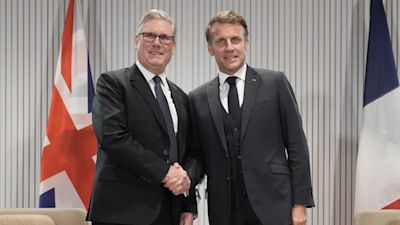
Key European allies pledged to send a “reassurance force” to Ukraine in a move described as a significant step in the effort to end Russia’s nearly four-year invasion.
Ukrainian President Volodymyr Zelenskyy, French President Emmanuel Macron, and British Prime Minister Keir Starmer signed a declaration of intent on Tuesday for the deployment of multinational forces to support Kyiv’s defence and reconstruction – if a ceasefire with Russia is agreed on.
The announcement follows a meeting of more than two dozen countries in Paris. The nations dubbed the “coalition of the willing” have explored for months how to deter any future Russian aggression should it agree to stop fighting Ukraine.
There was no immediate response from Russia, however. President Vladimir Putin has ruled out any deployment of troops from NATO countries on Ukrainian soil.
Kyiv has long said it cannot be safe without guarantees that are comparable to the NATO alliance’s mutual defence agreement Article 5 to deter Russia from attacking again.
Zelenskyy welcomed the promised security guarantees for Ukraine.
“It’s important that today the coalition has substantive documents. These are not just words. There is concrete content: a joint declaration by all the coalition countries and a trilateral declaration by France, Britain, and Ukraine,” he said.
“It has been defined how those forces will be managed and at what levels command will be exercised,” Zelensky added.
Macron said “several thousand” French soldiers could be deployed to Ukraine to maintain peace.
“These are not forces that will be engaged in combat,” Macron told France 2 television on the sidelines of the summit, calling such a deployment “a force of reassurance”.
Starmer said allies will participate in US-led monitoring and verification of any ceasefire, support the long-term provision of armaments for Ukraine’s defence.
The UK and France will “establish military hubs across Ukraine and build protected facilities for weapons and military equipment to support Ukraine’s defensive needs” – in the event of a peace deal with Russia, he added.
Starmer said peace in Ukraine is closer than ever though the “hardest yards” still lay ahead.
US envoy Steve Witkoff said there was significant progress made on several critical issues facing Ukraine including security guarantees and a “prosperity plan”. Security protocols for Ukraine are “largely finished”, he added.
“We agree with the coalition that durable security guarantees and robust prosperity commitments are essential to a lasting peace in the Ukraine, and we will continue to work together on this effort,” Witkoff said in a post on X after talks in Paris.
Ukraine’s reconstruction is inextricably linked to security guarantees, German Chancellor Friedrich Merz said.
“Economic strength will be indispensable to guarantee that Ukraine will continue to credibly block Russia in the future,” Merz said.
However, he noted Ukraine and its European allies will have to accept “compromises” to achieve a peace deal.
“We will certainly have to make compromises” to end the nearly four-year-old war. “We will not achieve textbook diplomatic solutions,” said Merz.
Moscow has revealed few details of its stance in the US-led peace negotiations. Officials have reaffirmed Russia’s demands and insisted there can be no ceasefire until a comprehensive settlement is agreed. (AlJazeera)
 English