
Paul Thomas Anderson’s “One Battle After Another” was crowned best picture at the 98th Academy Awards, handing Hollywood’s top honor to a comic, multi-generational American saga of political resistance.
The ceremony Sunday, which also saw Michael B Jordan win best actor and “Sinners” cinematographer Autumn Durald Arkapaw make Oscar history as the first female director of photography to win the award, was a long-in-coming coronation for Anderson, a San Fernando Valley native who made his first short at age 18 and has been one of America’s most lionized filmmakers for decades. Before Sunday, Anderson had never won an Oscar.
But “One Battle After Another,” the favorite coming in, won six Oscars, including best director and best adapted screenplay for Anderson, the Oscars’ first trophy for best casting and best supporting actor for an absent Sean Penn.
“I wrote this movie for my kids to say sorry for the housekeeping mess that we left in this world — we’re handing off to them,” said Anderson while accepting the screenplay trophy. “But also with the encouragement that they will be the generation that hopefully brings us some common sense and decency.”
Ryan Coogler’s Jim Crow-set, blues-soaked vampire tale “Sinners,” which came in with a record 16 nominations, also landed some big and even historic wins. Coogler, the widely loved filmmaker, won the first Oscar in an unblemished career that started out with Jordan in 2013’s “Fruitvale Station.”
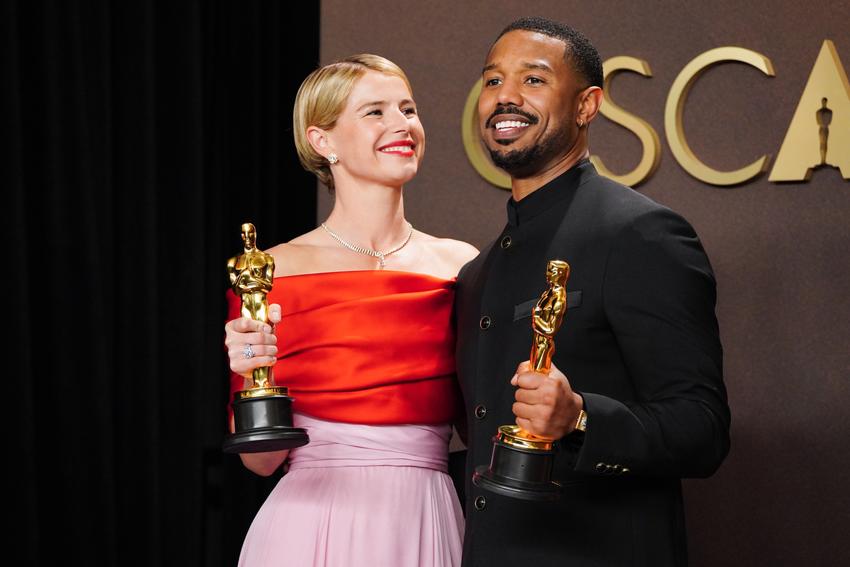
Arkapaw was also the first Black person to win for best cinematography. Only the fourth female cinematographer ever nominated, her win was a long-in-coming triumph for women behind the camera.
“I really want all the women in room to stand up,” said Arkapaw. “Because I don’t feel like I get here without you guys.”
And Jordan, one of Hollywood’s most liked leading men, won best actor in one of the night’s closest races. The Dolby Theatre rose to its feet in the most thunderous applause of the night.
“Yo, momma, what’s up?” said Jordan after staggering to the stage.
The Oscar night belonged to Warner Bros., the studio of “One Battle After Another” and “Sinners,” which scored a record-tying 11 wins. It was an oddly poignant note of triumph for the fabled studio, which weeks earlier agreed to a sale to Paramount Skydance, David Ellison’s rapidly assembled media monolith. The $111 billion deal, which awaits regulatory approval, has Hollywood bracing for more layoffs.
But “Sinners” and “One Battle After Another” — the much-acclaimed heavyweights of the season — were each Hollywood anomalies: big-budget originals born from a personal vision. In a year where anxiety over studio contraction and the rise of artificial intelligence often consumed the industry, both films gave Hollywood fresh hope.
Jessie Buckley won best actress for her performance as Agnes Shakespeare in “Hamnet,” making her the first Irish performer to ever win in the category. At an Oscars where no other acting award seemed a sure thing, Buckley cruised into Sunday’s Oscars at the Dolby Theatre as the overwhelming favorite.
“It’s Mother’s Day in the UK,” said Buckley on the stage. “I would like to dedicated this to the beautiful chaos of a mother’s heart.”
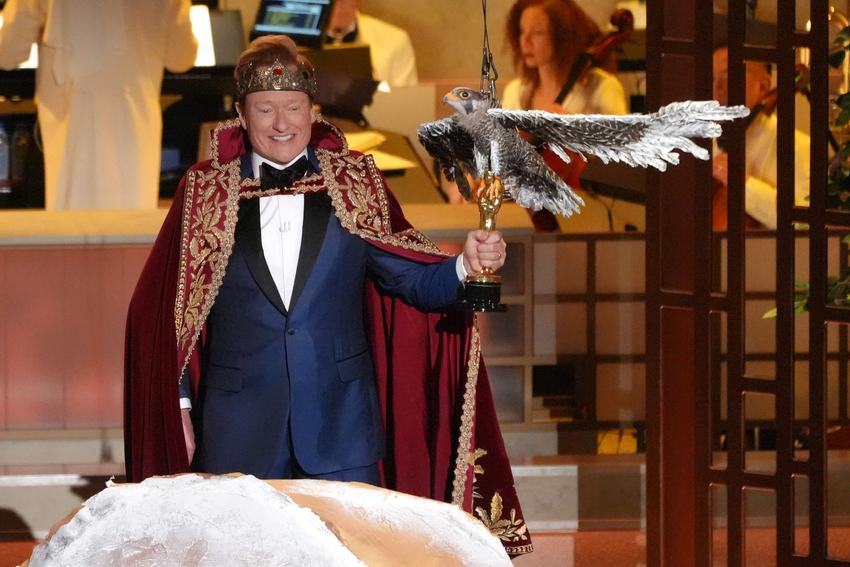
From the start, when host Conan O’Brien sprinted through the year’s nominees as Amy Madigan’s character in the horror thriller “Weapons” in a pre-taped bit, Sunday’s ceremony was quirky, a little clunky and preoccupied with the shifting place of movies in culture. There was, of all things, a tie for best live-action short film.
As expected, the Netflix sensation “KPop Demon Hunters,” 2025’s most-watched film, won best animated feature, as well as best song for “Golden.” It was a big win for Netflix but a more qualified victory for the movie’s producer, Sony Pictures. Though it developed and produced the film, Sony sold “KPop Demon Hunters” to the streaming giant instead of giving it a theatrical release.
On Netflix, “KPop Demon Hunters” became a cultural phenomenon and the streaming platform’s biggest hit. It has more than 325 million views and counting.
“This is for Korea and Koreans everywhere,” said co-director Maggie Kang.
Another Netflix release, Guillermo del Toro’s “Frankenstein” picked up three awards for its lavish craft, for costume design, makeup and hairstyling and for production design.
Amy Madigan won best supporting actress for her performance in the horror thriller “Weapons,” a win that came 40 years after the 75-year-old actor was first nominated, in 1986, for “Twice in a Lifetime.” Letting out a giant laugh as she hit the stage, Madigan exclaimed, “This is great!”
Hosting for the second time, O’Brien began the Dolby Theatre show alluding to “chaotic and frightening times.” But he argued that the current geopolitical climate made the Oscars all the more resonate as a globally unifying force.
“We pay tribute tonight, not just to film, but to the ideals of global artistry, collaboration, patience, resilience and that rarest of qualities today — optimism,” O’Brien said. “We’re going to celebrate. Not because we think all is well, but because we work, and hope, for better.”
Throughout the show, O’Brien hit a number of targets, like Timothée Chalamet — who again missed out on winning his first Oscar, this time for “Marty Supreme” — for his diss of opera and ballet. But the ceremony seldom wasn’t shadowed by politics, whether in references to changes under U.S. President Donald Trump or the recently launched war in Iran.
Joachim Trier, whose Norwegian family drama “Sentimental Value” won best international film, quoted James Baldwin in his acceptance speech: “All adults are responsible for all children,” he said. “Let’s not vote for politicians that don’t take this seriously into account.”
Presenter Jimmy Kimmel, whose late-night show last year was suspended after comments he made about Charlie Kirk’s killing, was among the most blunt.
“There are some countries that don’t support free speech,” said Kimmel. “I’m not at liberty to say which. Let’s just leave it at North Korea and CBS.”
Shortly after, “Mr. Nobody Against Putin,” a film about a Russian primary schoolteacher who documents his students’ indoctrination to support Russia’s war with Ukraine, won best documentary.
“’Mr. Nobody Against Putin’ is about how you lose your country,” co-director said. “And what we saw when working with this footage is that you lose it through countless, small, little acts of complicity.”
“We all face a moral choice,” he added, “but, luckily, a nobody is more powerful than you think.”
Elegy also marked the Oscars. Producers expanded the in memoriam segment following a year that featured the deaths of so many Hollywood legends, including Keaton, Robert Duvall and Redford. Barbra Streisand spoke about Redford, her “The Way We Were” co-star.
“Bob had real backbone,” said Streisand, who called Redford “an intellectual cowboy” before singing a few bars of “The Way We Were.”
Billy Crystal paid tribute to Rob and Michele Reiner, who were killed in their home in December. Crystal, a close friend of Rob Reiner’s who memorably starred in 1989’s “When Harry Met Sally…” and 1987’s “Princess Bride.” In his moving remarks, Crystal quoted the latter.
“All we can say is: Buddy, how much fun we had storming the castle,” said Crystal.
Yet again, the night’s final award again didn’t go to a streaming release; Apple’s “CODA” remains the only streaming film to achieve that distinction. “Sinners” and “One Battle After Another” were both theatrical releases shot on film.
Apple’s top contender this time, the Formula One race drama “F1,” a movie that it partnered with Warner Bros. to distribute theatrically, won for best sound. The lone blockbuster of the year to go home with a win was “Avatar: Fire and Ash,” for visual effects.
Some of O’Brien’s best digs came at the expense of the streamers. Netflix chief Ted Sarandos, he joked, was in a theater for the first time. The host also lamented the lack of nominees for Amazon MGM: “Why isn’t the website I order toilet paper from winning more Oscars?”
“I’m honored to be the last human host of the Academy Awards,” said O’Brien. “Next year it’s going to be a Waymo in a tux.” (JapanToday)

 English