Posted on Leave a comment

‎Alcaraz beats Sinner to win US Open, reclaims No.1 ranking

Carlos Alcaraz beat Jannik Sinner in four sets on Sunday to win the US Open as loud boos — mixed with a smattering of cheers — greeted President Donald Trump at the final in New York.

‎The 22-year-old Alcaraz won 6-2, 3-6, 6-1, 6-4 to capture his second US Open crown and sixth Grand Slam title, avenging his lone defeat in a major final by Sinner at Wimbledon in July.

‎Alcaraz will reclaim the world number one ranking from Sinner, returning to top spot for the first time since September 2023 after ending the Italian’s 27-match winning run at hard-court Grand Slams.

‎”I tried my best today. I couldn’t do more,” said Sinner, who was also defeated by Alcaraz in an epic French Open final in June.

‎Sinner’s defeat extends the longest drought without a successful men’s title defence of any Grand Slam in the Open era.

‎No man has retained the US Open crown since Roger Federer won five in a row from 2004 to 2008.

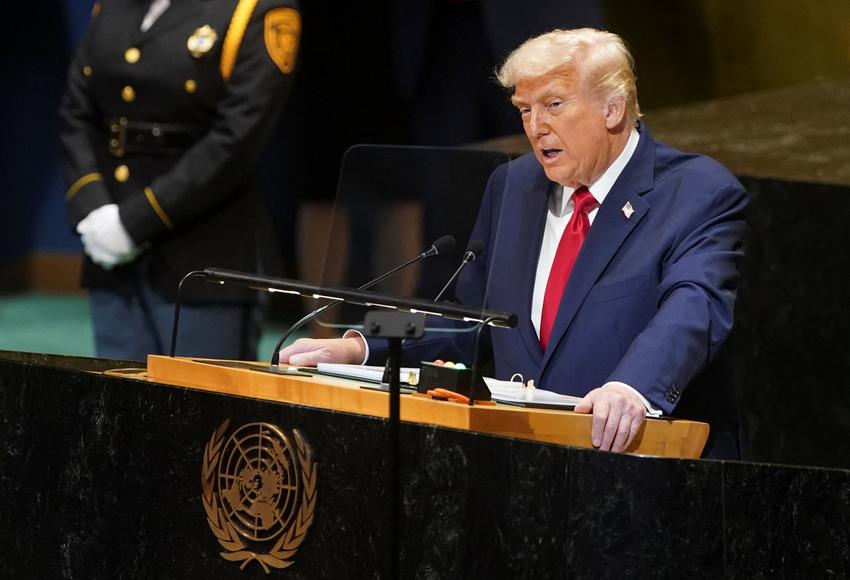
‎Anticipation for the third straight Grand Slam final between the sport’s top two players assumed an even greater dimension with the presence of Trump.

‎It was the latest in a series of visits to major sporting events for the US leader after his trip to the NFL’s Super Bowl in February and the FIFA Club World Cup final in July.

‎He appeared before the playing of the Star-Spangled Banner, waving to the crowd, which greeted him with a mix of cheers and boos. He was given a frostier reception later in the match though when shown again on the stadium’s big screens.

‎A constellation of showbiz and sports icons turned out as well, with rock star Bruce Springsteen, fashion icon Tommy Hilfiger, actor Michael Douglas and basketball superstar Stephen Curry all on hand.

‎The start of the final was pushed back 30 minutes to allow fans additional time to enter Arthur Ashe Stadium as a result of tighter security measures in effect due to Trump’s attendance.

‎Even then the 23,000-capacity venue was no more than three-quarters full when Alcaraz broke Sinner in the opening game of the match.

‎As he did in the Wimbledon final, Alcaraz pinned Sinner on the back front early and broke a second time for a 5-2 lead before serving out to love.

‎With hundreds of spectators still waiting to get in at the start of the second set, Alcaraz sought to hammer home his advantage.

‎He created a break point but Sinner hung on and stalled Alcaraz’s momentum, belatedly ramping up his game and surging 3-1 ahead as the Spaniard suffered a brief dip on serve.

‎Sinner levelled the contest at a set apiece but Alcaraz stormed back with another break early in the third, wriggling out of a tight spot on serve with the help of a sensational baseline smash that sliced away from his rival for a 3-0 edge.

‎He padded his lead with another break and quickly wrapped up the set, keeping his foot down to corner Sinner again to begin the fourth set.

‎This time Sinner saved two break points but Alcaraz made another charge in the fifth game, delivering the decisive blow for an advantage he never relinquished as the Spaniard became only the fourth man to win multiple majors on hard court, grass and clay. (Punch)

Posted on Leave a comment

Trump to rebrand Pentagon as Department of War

US President Donald Trump is directing that the Pentagon be known as the Department of War.

He will sign an executive order on Friday for the Department of Defense to use the new name as a secondary title and for Defence Secretary Pete Hegseth to be known as Secretary of War.

The Pentagon – which oversees the US armed services – is the successor to the War Department, which was first established as a cabinet-level agency in 1789 and existed until 1947.

The responsibility of creating executive departments rests with the US Congress, meaning that an amendment would be required to legally change the department’s name.

The BBC has seen the text of the executive order, which says: “The name ‘Department of War’ conveys a stronger message of readiness and resolve compared to ‘Department of Defense,’ which emphasizes only defensive capabilities.”

Trump has repeatedly floated the idea of the name change, arguing that the US had “an unbelievable history of victory” in both world wars under the previous name.

He has also expressed optimism that lawmakers would support such a change.

“I’m sure Congress will go along if we need that. I don’t even think we need that,” the president said last week. “But, if we need that, I’m sure Congress will go along.”

Trump and Hegseth have sought to refocus the department on “warfighting” and a “warrior ethos”.

They have argued that the department has become too focused on diversity, equity and inclusion programmes and “woke ideology”. (BBC)

Posted on Leave a comment

Trump administration moves to fire most Voice of America journalists

The Trump administration has moved to terminate almost 500 employees of federally funded news organisation Voice of America (VOA).

The step is the latest in President Donald Trump’s drive to strip back the outlet, which the White House has accused of being “radical”.

Acting CEO of VOA’s parent agency, Kari Lake, said the decision would “help reduce the federal bureaucracy, improve agency service, and save the American people more of their hard-earned money.” A union representing employees called the step illegal in a statement to the New York Times.

VOA was set up during World War Two to counter Nazi propaganda, and has become a major global broadcaster.

The outlet is overseen by the Agency for Global Media (USAGM), which said a total of 532 positions would be eliminated. The majority of those employees are from VOA, which would be left with 108 staff, according to a court filing.

In June, Lake announced 639 employees would be terminated, although the notices were later rescinded due to paperwork errors. Some employees also filed lawsuits to block the terminations.

The announcement late on Friday night came a day after a judge ruled the Trump administration had not followed proper procedures in its attempt to fire VOA’s director, Michael Abramowitz. The judge also ordered Lake to sit for a deposition, where she would be questioned by lawyers.

The lawsuit was brought by a group of agency employees trying to block attempts to close down VOA.

“We find Lake’s continued attacks on our agency abhorrent,” they said in a statement to the BBC’s US partner CBS News.

“We are looking forward to her deposition to hear whether her plan to dismantle VOA was done with the rigorous review process that Congress requires. So far we have not seen any evidence of that, and as such we will continue to fight for what we believe to be our rights under the law.”

Most of VOA’s journalists have been on administrative leave since March but some Farsi-speaking staff were called back as war between Israel and Iran broke out this summer.

The notices will also not affect journalists working in its Office of Cuba Broadcasting division, which broadcasts news in Spanish from Miami.

Critics say Trump’s attempts to strip back VOA amount to an attack on press freedom, and impacts America’s ability to exercise soft power abroad. The administration has accused the outlet of being “anti-Trump” and “radical”.

VOA broadcasts TV, radio and digital content in almost 50 languages. (BBC)

Posted on Leave a comment

US court rules many of Trump’s global tariffs are illegal

A US appeals court has ruled that most tariffs issued by US President Donald Trump are illegal, setting up a potential legal showdown that could upend his foreign policy agenda.

The ruling affects Trump’s so-called “reciprocal” tariffs, imposed on most countries around the world, as well as other tariffs slapped on China, Mexico and Canada.

In a 7-4 decision, the US Court of Appeals for the Federal Circuit rejected Trump’s argument that the tariffs were permitted under an emergency economic powers act, calling them “invalid as contrary to law”.

The ruling will not take effect until 14 October, to give the administration time to ask the US Supreme Court to take up the case.

Trump criticised the appeals court and its ruling on Truth Social, saying: “If allowed to stand, this Decision would literally destroy the United States of America.”

He wrote: “Today a Highly Partisan Appeals Court incorrectly said that our Tariffs should be removed, but they know the United States of America will win in the end.

“If these Tariffs ever went away, it would be a total disaster for the Country. It would make us financially weak, and we have to be strong.”

Trump had justified the tariffs under the International Emergency Economic Powers Act (IEEPA), which gives the president the power to act against “unusual and extraordinary” threats.

Trump has declared a national emergency on trade, arguing that a trade imbalance was harmful to US national security. But the court ruled that imposing tariffs was not within the president’s mandate, and that setting levies was “a core Congressional power”.

In its 127-page judgement, the US Court of Appeals for the Federal Circuit said the IEEPA “neither mentions tariffs (or any of its synonyms) nor has procedural safeguards that contain clear limits on the president’s power to impose tariffs”.

The power to impose taxes and tariffs therefore continues to belong to Congress, the court ruled, and the IEEPA did not override this.

The court wrote that it was unlikely that, when Congress passed the law in 1977, it was intended to “depart from its past practice and grant the president unlimited authority to impose tariffs”.

“Whenever Congress intends to delegate to the president the authority to impose tariffs, it does so explicitly, either by using unequivocal terms like tariff and duty, or via an overall structure which makes clear that Congress is referring to tariffs,” the judges wrote.

The ruling comes in response to two lawsuits filed by small businesses and a coalition of US states.

They were brought after Trump’s executive orders in April, which imposed a baseline 10% tariff on almost every country in the world, as well as “reciprocal” tariffs intended to correct trade imbalances with dozens of countries. Trump declared the date to be America’s “liberation day” from unfair trade policies.

In May, the New York-based Court of International Trade declared the tariffs were unlawful. That decision was put on hold during the appeal process.

In addition to those tariffs, Friday’s ruling also strikes down tariffs on Canada, Mexico and China, which Trump argues are necessary to stop the importation of drugs.

However, the decision does not apply to other tariffs, like those imposed on steel and aluminium, which were brought in under a different presidential authority.

Ahead of the ruling, lawyers for the White House argued that invalidating the tariffs would lead to a 1929-style financial collapse, a stock market crash which led to the Great Depression.

“Suddenly revoking the president’s tariff authority under IEEPA would have catastrophic consequences for our national security, foreign policy, and economy,” they wrote in a letter.

“The president believes that our country would not be able to pay back the trillions of dollars that other countries have already committed to pay, which could lead to financial ruin.”

The ruling also raises questions about deals some nations agreed with the US for reduced tariffs rates.

The latest development means the case is now almost certain to head to the Supreme Court, which has in recent years taken a sceptical view toward presidents who try to implement sweeping new policies that are not directly authorised by Congress.

During Joe Biden’s presidency, the court expanded on what it called the “major questions doctrine” to invalidate Democratic efforts to use existing laws to limit greenhouse gas emissions by power plants and to forgive student loan debt for millions of Americans.

The top court’s nine justices, if they agree to consider the case, could weigh whether Trump’s expansive tariff programme is another example of presidential overreach or sufficiently grounded in law and presidential authority.

Even though the appellate court handed the president a defeat, the White House may take solace in the fact that only three of the court’s 11 judges were appointed by Republicans.

The Supreme Court has six Republican appointees, including three who were selected by Trump himself. (BBC)

Posted on Leave a comment

Shooter kills 2 children in Minneapolis church, 17 people injured

A gunman opened fire Wednesday on school children attending church in Minneapolis, killing two pupils and wounding 17 people, police said, in the country’s latest violent tragedy.

Minneapolis Police Chief Brian O’Hara told a media briefing that the shooter, in his early twenties, sprayed bullets into the Annunciation Church as dozens of students were at Mass to celebrate their first week back to school.

The church sits next to an affiliated school in the south of the city, the largest in the state of Minnesota.

“Two young children, ages eight and 10, were killed where they sat in the pews,” O’Hara said, adding that 17 others were injured, including 14 children.

Two were in critical condition, he said.

The gunman fired a rifle, shotgun and pistol before he took his own life in the parking lot, according to the police chief.

Minnesota Governor Tim Walz wrote on X earlier that he was “praying for our kids and teachers whose first week of school was marred by this horrific act of violence.”

Live video footage showed panicked parents retrieving their young children and fleeing amid a major emergency response.

“This was a deliberate act of violence against innocent children and other people worshiping. The sheer cruelty and cowardice of firing into a church full of children is absolutely incomprehensible,” O’Hara said.

“Our hearts are broken for the families who have lost their children, for these young lives that are now fighting to recover, and for our entire community that has been so deeply traumatized by this senseless attack,” he added.

Wednesday’s violence is the latest in a long line of school shootings in the United States, where guns outnumber people and attempts to restrict access to firearms face perennial political deadlock.

“Don’t just say this is about thoughts and prayers right now. These kids were literally praying. It was the first week of school. They were in a church. These are kids that should be learning with their friends,” Minneapolis Mayor Jacob Frey told reporters.

“They should be playing on the playground. They should be able to go to school or church in peace without the fear or risk of violence.”

President Donald Trump said he had been briefed on the “tragic shooting” and that the FBI was responding.

“The White House will continue to monitor this terrible situation. Please join me in praying for everyone involved!” he wrote on his Truth Social platform.

The confirmed shooting comes after a wave of false reports of active shooters at US college campuses around the country as students return from summer break. (Channels)

Posted on Leave a comment

Nvidia and AMD to pay 15% of China chip sales to US

Chip giants Nvidia and AMD have agreed to pay the US government 15% of Chinese revenues as part of an “unprecedented” deal to secure export licences to China, the BBC has been told.

The US had previously banned the sale of powerful chips used in areas like artificial intelligence (AI) to China under export controls usually related to national security concerns.

Security experts, including some who served during President Donald Trump’s first term, recently wrote to the administration expressing “deep concern” that Nvidia’s H20 chip was “a potent accelerator” of China’s AI capabilities.

Trump on Monday dismissed security concerns, saying the chip in question was “old”.

Under the agreement, Nvidia will pay 15% of its revenues from H20 chip sales in China to the US government.

AMD will also give 15% of revenue generated from sales of its MI308 chip in China to the Trump administration, which was first reported by the Financial Times.

Nvidia told the BBC: “We follow rules the US government sets for our participation in worldwide markets.”

It added: “While we haven’t shipped H20 to China for months, we hope export control rules will let America compete in China and worldwide.”

AMD did not immediately respond to a request for comment.

The deal sparked surprise and concern in the US, where critics said it raised security risks and questions about the Trump administration’s approach to dealing with private businesses.

“You either have a national security problem or you don’t,” said Deborah Elms, head of trade policy at the Hinrich Foundation.

“If you have a 15% payment, it doesn’t somehow eliminate the national security issue,” she added.

On social media, some investors called the arrangement a “shakedown”, while others compared the requirement to a tax on exports – which has long been considered illegal in the US.

“Regardless of whether you think Nvidia should be able to sell H20s in China, charging a fee in exchange for relaxing national security export controls is a terrible precedent,” wrote Peter Harrell, a fellow at the Carnegie Endowment for International Peace who formerly worked for the Biden administration.

“In addition to the policy problems with just charging Nvidia and AMD a 15% share of revenues to sell advanced chips in China, the US Constitution flatly forbids export taxes,” he added.

Democratic congressman Jake Auchincloss said: “Now the US government is financially motivated to sell AI to China? Makes me shudder to think what a TikTok deal might look like.”

The H20 chip was developed specifically for the Chinese market after US export restrictions were imposed by the Biden administration in 2023.

Sales of the chip were effectively banned by Trump’s government in April this year.

Beijing has previously criticised the US government, accusing it of “abusing export control measures, and engaging in unilateral bullying”.

Nvidia’s chief executive Jensen Huang has spent months lobbying both sides for a resumption of sales of the chips in China.He reportedly met US President Donald Trump last week.

Charlie Dai, vice president and principal analyst at global research firm Forrester, said the agreement to hand over 15% of China chip sales to the US government in exchange for export licences was “unprecedented”.

“The arrangement underscores the high cost of market access amid escalating tech trade tensions, creating substantial financial pressure and strategic uncertainty for tech vendors,” he added.

In a letter last month to US Commerce Secretary Howard Lutnick, a group of 20 security specialists said that while the biggest buyers of Nvidia’s H20 chips were civilian companies in China, they expect them to be used by the military.

They wrote: “Chips optimized for AI inference will not simply power consumer products or factory logistics; they will enable autonomous weapons systems, intelligence surveillance platforms and rapid advances in battlefield decision-making.”

In a statement to the BBC, Nvidia said: “America cannot repeat 5G and lose telecommunication leadership. America’s AI tech stack can be the world’s standard if we race.”

The Nvdia and AMD agreement comes as the boss of Intel, a rival chip maker, met with Trump at the White House on Monday after the president called for his immediate resignation due to his ties to China.

Intel said the pair had “a candid and constructive discussion on Intel’s commitment to strengthening U.S. technology and manufacturing leadership”.

Trump wrote on Truth Social the meeting was “a very interesting one”.

“Mr. Tan and my Cabinet members are going to spend time together, and bring suggestions to me during the next week,” Trump added.

Last week, Trump said on social media that Lip-Bu Tan was “highly conflicted”, apparently referring to his alleged investments in companies that the US said were tied to the Chinese military.

Mr Tan pushed back, stating it was “misinformation”. (BBC)

Posted on Leave a comment

More than 60 countries scramble to respond to Trump’s latest tariffs

More than 60 countries around the world are scrambling to respond to the latest wave of US tariffs announced by Donald Trump, which came into force on Thursday.

Industry representatives in rich and poor countries warned of job losses as the tariffs upended a decades-old world trading system with rates ranging from 10% to 39%, 40% and 41% for Switzerland, Brazil and Syria.

All over the globe, leaders were attempting to put contingencies in place after Trump’s tariff threats turned to reality at a minute past midnight Washington time.

The Brazilian government said it was planning a state aid plan for companies affected. The president, Luiz Inácio Lula da Silva, said the duties were “unacceptable blackmail”.

Switzerland said it was seeking new talks with the US after a last-gasp mission to Washington by its president, Karin Keller-Sutter, failed to stop a 39% tariff blow that industry group Swissmem described as a “horror scenario”.

In a statement after an emergency meeting with Keller-Sutter, the Swiss cabinet said the tariffs would “place a substantial strain on Switzerland’s export-oriented economy”.

“For the affected sectors, companies and their employees, this is an extraordinarily difficult situation,” Keller-Sutter told reporters.

Taiwan is also continuing talks with the US. Its president, Lai Ching-te, said the 20% rate imposed on the key Washington ally was “temporary”.

Ireland, which is locked into an EU-US deal setting the tariff ceiling at 15%, said it would publish a new plan for diversifying an economy that relies heavily on US multinationals including Intel, Pfizer and Johnson & Johnson, all in Trump’s crosshairs.

Despite a last minute reprieve from Trump for Lesotho with tariffs dropping from 50% to 15%, the impoverished African nation said it was already hurting.

Textile industry players in the country – which produces jeans and other garments for US companies including Levi and Walmart – said the uncertainty around tariffs over the past few months had already devastated the sector, with orders cancelled and jobs cut.

Laos, which, like Brazil and Myanmar, was hit with a 40% rate, was among those handed a steep increase in import duties because of a trade imbalance with the US.

“A 40% tariff is just a nail in the coffin for any industry trying to ship to the United States,” Johannes Somers, the executive chair of the garment manufacturing firm Diep Vu, told Agence France Presse.

“We estimate about 20,000 workers or more could be impacted,” added Xaybandith Rasphone, the head of the Association of the Lao Garment Industry.

The sweeping “reciprocal” rates were announced by the White House a week ago, just before a previous 1 August deadline was due to elapse.

Just before the tariffs came into effect at midnight, Trump claimed on social media that billions of dollars would start flowing into the US as a result.

However, while the customs duties make countries’ exports more expensive and less competitive, they are payable on import and usually passed on to the customer.

“The only thing that can stop America’s greatness would be a radical left court that wants to see our country fail,” the president wrote in capital letters, referencing an ongoing case in the US court of appeals, which is considering whether he exceeded his authority in imposing the tariffs.

Some trading partners had already secured reductions through negotiations or by striking deals, including the UK, Thailand, Cambodia, Vietnam, Indonesia, the Philippines, Japan, South Korea, Pakistan and the EU.

The EU is the only trading partner where its baseline rate of 15% will include previous tariffs. It means, for example, cheeses that are normally hit with import duties of 14.9% will be taxed at 15% and not 29.9%.

However, the deal has only been implemented in part with tariffs of 27.5% still being imposed on EU car imports while the details of the US-EU deal are being finalised.

Hildegard Müller, the president of the German car industry federation, said the EU-US deal had “brought no clarity or improvement” to the industry.

“The sectoral tariffs on cars and automotive parts of 27.5%, which have been in effect since April and May respectively, remain in place and place a significant burden on German automakers and automotive suppliers, as well as on transatlantic trade.

“It is important that the promised agreement is reached now and the relief measures are implemented promptly,” she said.

India’s 25% tariff rate could rise to a total of 50% after Trump signed an executive order on Wednesday imposing an additional levy in retaliation for the country’s purchase of oil from Russia. Delhi has 21 days to respond. Trump has threatened to use the same tactic on other countries that supply Russia. (Guardian)

Posted on Leave a comment

Canada to recognise Palestinian state at UN General Assembly

Canada plans to recognise a Palestinian state at the UN General Assembly in September, Prime Minister Mark Carney said Wednesday, a major policy shift that drew an angry response from US President Donald Trump and was rejected by Israel.

Carney said the move was necessary to preserve hopes of a two-state solution to the Israeli-Palestinian conflict, a long-standing Canadian goal that was “being eroded before our eyes.”

“Canada intends to recognise the State of Palestine at the 80th Session of the United Nations General Assembly in September 2025,” the prime minister said.

This makes Canada — a G7 nation — the third country, following recent announcements by France and the United Kingdom, to signal plans to recognise a Palestinian state in September.

Carney said the worsening suffering of civilians in Gaza left “no room for delay in coordinated international action to support peace.”

Israel blasted Canada’s announcement as part of a “distorted campaign of international pressure,” while Trump warned that trade negotiations with Ottawa may not proceed smoothly.

“Wow! Canada has just announced that it is backing statehood for Palestine,” the US president wrote on his Truth Social platform.

“That will make it very hard for us to make a Trade Deal with them.”

Asked by reporters if there was a scenario where Canada could change its position before the UN meeting, Carney said: “There’s a scenario (but) possibly one that I can’t imagine.”

Canada’s intention “is predicated on the Palestinian Authority’s commitment to much-needed reforms,” Carney said, referring to the body led by President Mahmoud Abbas, which has civil authority in parts of the Israeli-occupied West Bank.

Carney said his plans were further predicated on Abbas’s pledge to “hold general elections in 2026 in which Hamas can play no part, and to demilitarise the Palestinian state.”

With Wednesday’s announcement, Carney positioned Canada alongside France, after President Emmanuel Macron said his country would formally recognise a Palestinian state during the UN meeting, the most powerful European nation to announce such a move.

The Israeli embassy in Ottawa said, “Recognising a Palestinian state in the absence of accountable government, functioning institutions, or benevolent leadership, rewards and legitimises the monstrous barbarity of Hamas on October 7, 2023.”

The PA’s Abbas welcomed the announcement as a “historic” decision, while France said the countries would work together “to revive the prospect of peace in the region.”

Canada’s plan goes a step further than this week’s announcement by British Prime Minister Keir Starmer.

Starmer said the UK will formally recognise the State of Palestine in September unless Israel takes various “substantive steps,” including agreeing to a ceasefire in Gaza.

Carney stressed that Canada has been an unwavering member of the group of nations that hoped a two-state solution “would be achieved as part of a peace process built around a negotiated settlement between the Israeli government and the Palestinian Authority.”

“Regrettably, this approach is no longer tenable,” he said, citing “Hamas terrorism” and the group’s “longstanding violent rejection of Israel’s right to exist.”

The peace process has also been eroded by the expansion of Israeli settlements across the occupied West Bank and east Jerusalem, Carney said.

The prime minister said a two-state solution was growing increasingly remote, with a vote in Israel’s parliament “calling for the annexation of the West Bank,” as well as Israel’s “ongoing failure” to prevent a humanitarian catastrophe in Gaza.

He framed his decision as one aimed at safeguarding Israel’s future.

“Any path to lasting peace for Israel also requires a viable and stable Palestinian state, and one that recognises Israel’s inalienable right to security and peace,” Carney said. (Punch)

Posted on Leave a comment

US FCC clears $8bn Skydance-Paramount merger

An $8bn (£5.9bn) merger between Paramount Global and Skydance Media has been approved by the US Federal Communications Commission (FCC).

The merger between the independent film studio and one of Hollywood’s oldest and most storied companies was first announced in 2024.

The approval came just weeks after Paramount Global agreed to pay $16m (£13.5m) to settle a legal dispute with US President Donald Trump over an interview it broadcast on subsidiary CBS with former Vice-President Kamala Harris.

The settlement did not include a statement of apology or regret.

FCC head Brendan Carr, who was appointed by the president, announced the merger’s approval on Thursday, saying he welcomed Skydance’s ideas to make “significant changes” at CBS.

The approval means the merger could be finalised soon but Paramount did not provide an expected completion date when asked by the BBC. Skydance did not immediately reply to a request for comment.

The FCC agreed to transfer broadcast licences for 28 owned-and-operated CBS television stations to the new owner.

“Americans no longer trust the legacy national news media to report fully, accurately, and fairly,” Mr Carr said. “It is time for a change.”

Mr Carr said Skydance had made promises to the agency, including a “commitment to unbiased journalism” where the merged company would install a ombudsman to evaluate complaints of bias.

Skydance also promised to end diversity, equity, and inclusion efforts, something the Trump administration has targeted.

The FCC voted 2-1 to approve the deal, with one commissioner, Anna Gomez, a Democrat, dissenting.

“After months of cowardly capitulation to this administration, Paramount finally got what it wanted. Unfortunately, it is the American public who will ultimately pay the price for its actions,” she wrote.

Paramount Global traces its origins back more than a century to the founding of Paramount Pictures Corporation in 1914. The studio has made many hit films, including the Godfather, Star Trek, and Mission: Impossible series.

Paramount owns streaming service Paramount+, as well as Paramount Pictures, CBS, Nickelodeon, BET, MTV, Comedy Central and other media brands.

But the entertainment giant has struggled over the past decade.

Skydance is owned by David Ellison, the son of Larry Ellison, who founded US technology giant Oracle.

The FCC’s approval was necessary for the deal to move forward.

The deal, which includes CBS, Paramount Pictures and Comedy Central, was approved after a series of moves by Paramount, including settling a lawsuit from Trump.

According to both the Wall Street Journal and New York Times, the settlement over the 60 Minutes interview was agreed – with the help of mediator – so as to not affect the planned merger, which the FCC was reviewing and therefore Trump technically had the power to halt.

Trump had alleged the network had deceptively edited an interview that aired on its 60 Minutes news programme with his presidential election rival Kamala Harris, to “tip the scales in favour of the Democratic party”.

Paramount said it would pay to settle the suit, but with the money allocated to Trump’s future presidential library, not paid to him “directly or indirectly”.

It also comes just days after CBS, owned by Paramount, announced it would end The Late Show with Stephen Colbert, who has been critical of Trump.

The network said the move “is purely a financial decision against a challenging backdrop in late night [television]” and “is not related in any way to the show’s performance, content or other matters”. (BBC)

Posted on Leave a comment

Ellen DeGeneres says she moved to Britain because of Trump

US TV star Ellen DeGeneres has made her first public appearance since moving to the UK, saying she decided to settle in England the day after Donald Trump was re-elected US president.

The comedian and host told a crowd in Cheltenham, Gloucestershire, that life “is just better” in the UK.

Ellen said she and wife Portia de Rossi were considering getting married again in England after some moves in the US to reverse the right to gay marriage, and that America can still be “scary for people to be who they are”.

She also addressed allegations of a toxic workplace that led to the end of her long-running chat show in 2022, admitting she could be “very blunt”, but dismissed the stories as “clickbait”.

Ellen was one of the biggest names on US TV for 30 years, thanks to her daytime chat show, as well as for her self-titled 1990s sitcom, for hosting the Oscars, Grammys and Emmys, and for voicing Dory in Finding Nemo.

After her talk show was cancelled, she went on a “final stand-up tour” in the US in 2024 then bought a house in the Cotswolds, a historic and picturesque area mainly spanning parts of Gloucestershire and Oxfordshire.

On Sunday at the Everyman theatre in nearby Cheltenham, she was in conversation with broadcaster Richard Bacon, who asked whether reports that she moved because of Donald Trump were correct. “Yes,” she replied.

The 67-year-old said she and De Rossi had initially planned to spend three or four months a year in the UK and bought what they thought would be “a part-time house”.

“We got here the day before the election and woke up to lots of texts from our friends with crying emojis, and I was like, ‘He got in’,” she said. “And we’re like, ‘We’re staying here’.”

Ellen has been giving glimpses of her new rural life on social media, in videos showing her farm animals including sheep – although they have now been sold after they kept escaping.

“It’s absolutely beautiful,” she said. “We’re just not used to seeing this kind of beauty. The villages and the towns and the architecture – everything you see is charming and it’s just a simpler way of life.

“It’s clean. Everything here is just better – the way animals are treated, people are polite. I just love it here.

“We moved here in November, which was not the ideal time, but I saw snow for the first time in my life. We love it here. Portia flew her horses here, and I have chickens, and we had sheep for about two weeks.”

On her last tour, she joked that she had been “kicked out of show business twice” – the first time being when she came out as gay in 1997.

That effectively led to the end of her sitcom after advertisers pulled out and the network stopped promoting it, she told the Cheltenham crowd on Sunday.

Bacon asked whether her visibility had encouraged other people to come out. “I would say no,” she replied. “I imagined a lot of people coming out like meerkats poking out of a hole and going back in again. ‘How’s she doing? OK, no, no.'”

But it is “a really hard decision” that doesn’t suit everyone, she continued, and said things are better today “in some ways” but not others.

“If it was [better], all these other people that are actors and actresses that I know they’re gay, they’d be out, but they’re not, because it’s still a problem. People are still scared.”

Ellen also referenced a recent move by the Southern Baptist Convention to endorse the reversal of a Supreme Court case allowing same-sex marriage. At least nine state legislatures have introduced bills to do the same.

“The Baptist Church in America is trying to reverse gay marriage,” she said. “They’re trying to literally stop it from happening in the future and possibly reverse it. Portia and I are already looking into it, and if they do that, we’re going to get married here.”

Later, in response to an audience question, she added: “I wish we were at a place where it was not scary for people to be who they are. I wish that we lived in a society where everybody could accept other people and their differences.

“So until we’re there, I think there’s a hard place to say we have huge progress.”

However, the younger generation are “more comfortable with it” and are “just kind of fluid”, she added. “So I think the younger generation is going to show us the way.”

After some former workers on her talk show made allegations of a toxic workplace culture, the star – who ended every episode by telling viewers to “be kind to one another” – was dubbed as “mean” in the media.

Following the scandal three producers were sacked amid allegations of misconduct and sexual harassment, and the final season of the show opened with Ellen giving an on-air apology.

She addressed that in her 2024 tour and the accompanying Netflix stand-up special.

“No matter what, any article that came up, it was like, ‘She’s mean’, and it’s like, how do I deal with this without sounding like a victim or ‘poor me’ or complaining? But I wanted to address it.

“It’s as simple as, I’m a direct person, and I’m very blunt, and I guess sometimes that means that… I’m mean?” (BBC)