
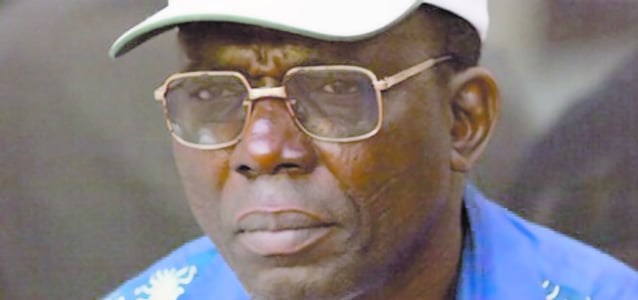
Tributes are still pouring in for the late Super Eagles coach, Adegboye Onigbinde, who passed away on Monday.
Led by the National Sports Commission and the Nigeria Football Federation, Onigbinde’s passing has been described as “the exit of a great man who served Nigerian football wholeheartedly and was diligent and devoted to the development of the game.”
“His legacies as a former national team coach and former CAF and FIFA technical instructor will continue to shape the sport for decades to come. A true legend has gone home. Rest on, High Chief,” the Director-General of the NSC, Bukola Olopade, wrote.
Similarly, the Director-General and Chief Executive Officer of the National Institute for Sports, Philip Shaibu, said, “Coach Onigbinde represents an era of discipline, courage and football intelligence. At the National Institute for Sports, we believe our legends must be celebrated, respected and preserved as national treasures while we also tap into their experience and wisdom in navigating our core mandate. Unfortunately, as part of the natural course of life, he is no longer with us.”
NFF General Secretary Dr Mohammed Sanusi said the Modakeke high chief was “an extraordinary achiever who impacted positively not only on Nigerian football but on the African and global game at large.”
“Indeed, a big tree has fallen. Chief Onigbinde ate, drank, breathed, slept and lived football development. We will miss him greatly, as he was never tired of offering advice on the game’s development even at his ripe old age. We pray that God will grant him eternal rest and also grant his family, relations, friends and the Nigerian football fraternity the fortitude to bear the loss.”
The Nigeria Football Coaches Association also paid tribute to the man widely regarded as a trailblazer of coaching education in the country.
“Beyond his technical contributions on the pitch, he was a respected leader, mentor and elder statesman whose influence extended through generations of coaches, players and football administrators across Nigeria and Africa,” the association said in a statement.
Respected globally for his deep knowledge of the game’s tactics and techniques, Onigbinde served as Technical Director of the Nigeria Football Federation and also as Technical Adviser to the Trinidad and Tobago Football Federation, where he worked with the country’s youth teams. He was for many years a technical adviser to the Confederation of African Football and also served on several Technical Study Groups of FIFA and CAF at major championships.
He began his coaching career in the 1960s and rose to national prominence in 1977, when he led Water Corporation FC of Ibadan to the quarter-finals of the African Cup of Champions Clubs. Seven years later, he guided Shooting Stars Sports Club of Ibadan to the final of the same competition.
A quintessential teacher, educator and instructor, Onigbinde was the first indigenous coach to lead Nigeria’s senior men’s national team to an Africa Cup of Nations silver medal, achieving the feat with a largely youthful squad at the 1984 tournament in Côte d’Ivoire.
The cerebral tactician later guided the Super Eagles to the 2002 FIFA World Cup in Korea and Japan, where a blend of emerging talents and experienced players narrowly lost to Argentina and Sweden and drew with England. He became the first Nigerian coach to manage the Super Eagles at the FIFA World Cup, following foreign managers Clemens Westerhof (1994) and Bora Milutinović (1998).
Afterwards, he served as an instructor and educator for the NFF, CAF and FIFA, dedicating his time to training coaches and football administrators, a contribution that earned him recognition and accolades across the football world. (Punch)
 English