
Posted on Leave a comment

Odegbami tells NFF, NSC to immortalise Onigbinde

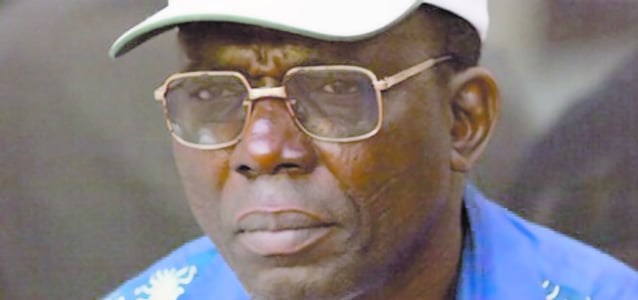
Former Super Eagles captain and 1980 Africa Cup of Nations winner, Segun Odegbami, has urged the Nigeria Football Federation and the National Sports Commission to immortalise the late Super Eagles coach, Adegboye Onigbinde, to preserve his legacy in Nigerian football, The PUNCH reports.

Onigbinde, who handled the Nigeria national team twice and also served as a CAF and FIFA instructor, died on Monday, March 9, at the age of 88.

The Modakeke-born coach first led Nigeria between 1982 and 1984, guiding the Green Eagles to a second-place finish at the 1984 AFCON in Ivory Coast. The achievement made him the first Nigerian coach to win an AFCON medal.

He returned in 2002 as the Technical Director of the Nigeria Football Association and led a new-look Super Eagles side to the 2002 FIFA World Cup in Korea and Japan.

While tributes have continued to pour in for the late tactician, Odegbami believes he deserves a permanent place in the history of Nigerian football.

“He stands out as one of the most successful Nigerians to coach the national team and work in coaching within the country. Nigeria must find a way to immortalise him. The Nigeria Football Federation and the National Sports Commission must ensure that he is immortalised. He deserves it,” Odegbami said during a radio programme, Sports Salsa, on Kennis FM.

“It is painful for all of us. His love for football, his passion for developing the game, and the feeling that he was not fully utilised to transform Nigerian football remain notable. But he has left a legacy that is unmatched. Nigerians should always remember him for his great contributions to our football history.”

Onigbinde also served as Technical Adviser to the Trinidad and Tobago Football Federation, where he oversaw the country’s youth teams.

The Nigeria Football Federation described his death as “the exit of a great man who served Nigeria football wholeheartedly and was diligent and devoted to the development of the game.”

For many years, he worked as a technical adviser to the Confederation of African Football and served on several Technical Study Groups for both FIFA and CAF at major international tournaments.

He began his coaching career in the 1960s and rose to national prominence in 1977 when he led Water Corporation FC of Ibadan to the quarter-finals of the African Cup of Champions Clubs. Seven years later, he guided Ibadan giants Shooting Stars to the final of the same competition.

Burial arrangements for the late coach will be announced by his family in the coming days. (Punch)
Posted on Leave a comment

Nigeria sports community mourns Onigbinde

Tributes are still pouring in for the late Super Eagles coach, Adegboye Onigbinde, who passed away on Monday.

Led by the National Sports Commission and the Nigeria Football Federation, Onigbinde’s passing has been described as “the exit of a great man who served Nigerian football wholeheartedly and was diligent and devoted to the development of the game.”

“His legacies as a former national team coach and former CAF and FIFA technical instructor will continue to shape the sport for decades to come. A true legend has gone home. Rest on, High Chief,” the Director-General of the NSC, Bukola Olopade, wrote.

Similarly, the Director-General and Chief Executive Officer of the National Institute for Sports, Philip Shaibu, said, “Coach Onigbinde represents an era of discipline, courage and football intelligence. At the National Institute for Sports, we believe our legends must be celebrated, respected and preserved as national treasures while we also tap into their experience and wisdom in navigating our core mandate. Unfortunately, as part of the natural course of life, he is no longer with us.”

NFF General Secretary Dr Mohammed Sanusi said the Modakeke high chief was “an extraordinary achiever who impacted positively not only on Nigerian football but on the African and global game at large.”

“Indeed, a big tree has fallen. Chief Onigbinde ate, drank, breathed, slept and lived football development. We will miss him greatly, as he was never tired of offering advice on the game’s development even at his ripe old age. We pray that God will grant him eternal rest and also grant his family, relations, friends and the Nigerian football fraternity the fortitude to bear the loss.”

The Nigeria Football Coaches Association also paid tribute to the man widely regarded as a trailblazer of coaching education in the country.

“Beyond his technical contributions on the pitch, he was a respected leader, mentor and elder statesman whose influence extended through generations of coaches, players and football administrators across Nigeria and Africa,” the association said in a statement.

Respected globally for his deep knowledge of the game’s tactics and techniques, Onigbinde served as Technical Director of the Nigeria Football Federation and also as Technical Adviser to the Trinidad and Tobago Football Federation, where he worked with the country’s youth teams. He was for many years a technical adviser to the Confederation of African Football and also served on several Technical Study Groups of FIFA and CAF at major championships.

He began his coaching career in the 1960s and rose to national prominence in 1977, when he led Water Corporation FC of Ibadan to the quarter-finals of the African Cup of Champions Clubs. Seven years later, he guided Shooting Stars Sports Club of Ibadan to the final of the same competition.

A quintessential teacher, educator and instructor, Onigbinde was the first indigenous coach to lead Nigeria’s senior men’s national team to an Africa Cup of Nations silver medal, achieving the feat with a largely youthful squad at the 1984 tournament in Côte d’Ivoire.

The cerebral tactician later guided the Super Eagles to the 2002 FIFA World Cup in Korea and Japan, where a blend of emerging talents and experienced players narrowly lost to Argentina and Sweden and drew with England. He became the first Nigerian coach to manage the Super Eagles at the FIFA World Cup, following foreign managers Clemens Westerhof (1994) and Bora Milutinović (1998).

Afterwards, he served as an instructor and educator for the NFF, CAF and FIFA, dedicating his time to training coaches and football administrators, a contribution that earned him recognition and accolades across the football world. (Punch)

Posted on Leave a comment

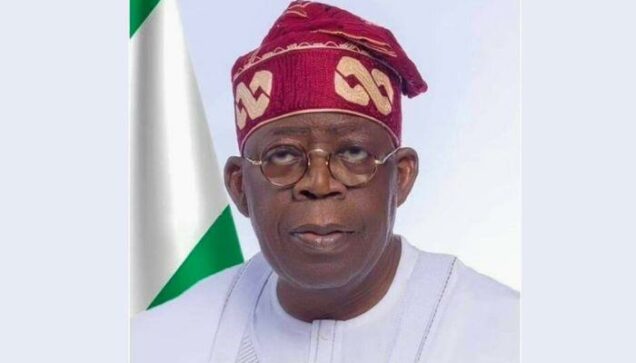
Nigeria ready, willing to host Commonwealth Games — Tinubu

Nigeria on Thursday welcomed the Commonwealth Sport Bid Evaluation Committee to Abuja, a major step towards hosting the 2030 Commonwealth Games.

President Bola Tinubu, represented by his Chief of Staff, Femi Gbajabiamila, formally received the delegation at the Aso Rock Villa, Abuja.

“What I can assure you is that we’re ready,” Tinubu told the delegation.

He reaffirmed Nigeria’s commitment to hosting an inclusive, diverse, and world-class 2030 Commonwealth Games on African soil.‎

Special Adviser to the President on Information and Strategy, Bayo Onanuga, revealed this in a statement he signed Thursday titled, ‘Nigeria ready to host Africa’s First Commonwealth Games in 2030-President Tinubu assures‎.’

Gbajabiamila, along with a strong Federal Government team of Ministers and senior government officials, held strategic talks with the delegation led by Darren Hall, Director of Games and Assurance at Commonwealth Sport, and a member of the 2030 Evaluation Commission.

President Tinubu emphasised that the Commonwealth champions unity and diversity, and Africa deserves its moment after nearly a century.‎

Africa has never hosted the Games since their inception in 1930. Nigeria made an unsuccessful bid to host the 2014 Games. The city of Durban in South Africa won the bid to host the 2022 Games, but could not do so due to financial difficulties. Birmingham in the UK took over and hosted the Games. Thus, Nigeria’s bid to host the 2030 Games would be historic, Onanuga stated.

In his welcome remarks, Gbajabiamila called on the visitors to savour Nigeria’s renowned hospitality: “You’re very welcome to Nigeria. I hope you enjoy our great hospitality, which we are known for. Mr President also asked me personally to convey his regards; he fully supports this bid.”‎

“The President has written a Letter of Guarantee to you; his full weight is behind this bid. What I can assure you is that we’re ready. We’re willing, we’re able, and we actually want this. It’s been almost 100 years. The games have not been held on any soil in Africa.

‎”The element of inclusivity is what the Commonwealth is, and we hope that will benefit us,” he stated.

President Tinubu stressed that his administration has set some bold reforms to reposition sports, having realised its role as a strategic driver of national development.

He added that he scrapped the Ministry of Sports and replaced it with the National Sports Commission in the bid to drive sports development.

The President further assured the delegation that all infrastructural, security, and hospitality needs will be met ahead of schedule.‎

He emphasised that Nigeria’s bid is not just about hosting but also leaving a legacy for youth and national development.‎

Chairman of the National Sports Commission, Shehu Dikko, made a strong case for Nigeria over India, stressing that Africa has 22 Commonwealth nations, and Nigeria, as the continent’s giant, deserves the honour.‎

“One thing I want to assure you is that the President sees the hosting of the Commonwealth Games in 2030, if we win the bid, as a celebration of the country’s growing force in sports, beyond just participation.”

‎President of Commonwealth Sport Nigeria, Habu Gumel, said the country is ready to host an environmentally sustainable Games.‎

Chairman of the Bid Committee, Mainasara Illo, presented Nigeria’s proposal, highlighting key plans and innovations.‎

He revealed that Nigeria proposes 15 sports, with football introduced to boost excitement, global visibility, and audience engagement.‎

Director of Games and Assurance, Darren Hall, thanked President Tinubu and the Nigerian team for their warm welcome.‎

“I have been most thrilled by the passion of the Nigerian people in all their endeavours, including sports.”

He said the Commonwealth, now comprising 56 nations, aims for greater diversity as it approaches its 100-year milestone.‎

Minister of Information and National Orientation, Muhammed Idris, Minister of Aviation, Festus Kayamo, Minister of Art, Culture, Tourism, and the Creative Economy, Hannatu Musa Musawa, Minister of Housing and Urban Development, Ahmed Musa Dangiwa and‎ Minister of Police Affairs, Ibrahim Gaidam, attended the meeting and made statements in support of the bid.

Nigeria and India are the two official bidders for the 2030 Games, with Abuja and Ahmedabad, in Gujarat, as their proposed host cities.‎

‎After a thorough evaluation of both bids, the Commonwealth Games General Assembly will decide the host city in November 2025.

PUNCH Online reports the next Commonwealth Games will be held in 2026 across four venues in Glasgow, Scotland, from July 23 to August 2. (Punch)