
Posted on Leave a comment

Nigeria provides protection to Guinea-Bissau opposition candidate amid coup

Nigeria has placed Guinea-Bissau’s opposition presidential candidate, Mr. Fernando Costa, under its protection following reports that his life is under threat.

Mr. Costa, the main challenger to President Umaro Embalo in the November 23 election, faced danger after soldiers seized power, halted the vote count, and imposed a nationwide curfew before the official results could be announced.

The Ministry of Foreign Affairs confirmed that President Bola Ahmed Tinubu approved Mr. Costa’s protection inside the Nigerian Embassy in Bissau. The decision was formalized in a letter dated November 30, signed by Foreign Affairs Minister Yusuf Tuggar, and addressed to the President of the ECOWAS Commission, Mr. Omar Alieu Touray.

According to the letter, Nigeria’s action is a proactive measure to safeguard democracy and ensure the safety of political actors in Guinea-Bissau. It also urged ECOWAS to direct its Stabilisation Support Mission in Guinea-Bissau (ESSMGB) to provide additional security for Mr. Costa while he remains at the embassy.

The letter states in part:

“His Excellency, President Bola Ahmed Tinubu, has graciously approved the provision of protection and security within the premises of the Nigerian Embassy in the Republic of Guinea-Bissau for Mr. Fernando Dia Da Costa. This decision is a proactive measure to ensure the safety of Mr. Da Costa in response to imminent threats to his life. It underscores our firm commitment to safeguarding the democratic aspirations and the sovereign will of the people of Guinea-Bissau.”

Nigeria’s intervention reflects its commitment to protecting democratic processes and supporting political stability in the West African region. (Vanguard)
Posted on Leave a comment

Ousted Guinea-Bissau president arrives in Congo

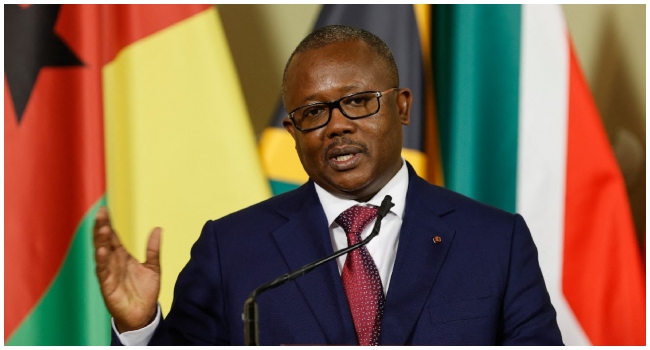
Guinea-Bissau’s ousted president Umaro Sissoco Embalo arrived in the Republic of Congo’s capital Brazzaville on Saturday, days after he was overthrown by the military, Congolese government sources told AFP.

Meanwhile in the capital Bissau, the West African country’s leading opposition party said its headquarters had been “invaded” by a “heavily armed militia”, in the wake of the post-election coup that propelled the army to power.

The military took control of the Portuguese-speaking nation on Wednesday — a day before the provisional results of national elections were due to be announced — and Embalo initially left for neighbouring Senegal.

The true motives for the coup in Guinea-Bissau remain unclear, with speculation and conspiracy theories circulating — including that the coup was carried out with Embalo’s blessing.

“Embalo arrived in Brazzaville late in the morning on a private jet,” a source close to the Congolese government said on condition of anonymity.

A presidency source said Embalo, who had claimed victory in the election, intended to remain in the country, which is also known as Congo-Brazzaville.

Embalo, 53, is rumoured to be close to Congolese President Denis Sassou Nguesso, and has visited the Republic of Congo many times.

After taking power on Wednesday, the officers in charge argued they had taken control to restore order, warning of a plot by the country’s drug barons to destabilise Guinea-Bissau.

The opposition and some experts however suspect that Embalo, in power since 2020, orchestrated the takeover to halt the electoral process.

Those suspicions intensified when the junta named General Horta N’Tam, considered a close ally of the president, to head a transitional administration set to last a year.

On Saturday, the African Party for the Independence of Guinea and Cape Verde (PAIGC), Guinea-Bissau’s powerful opposition party, said in a statement that its headquarters had been “illegally invaded by heavily armed militia groups” in Bissau.

Elsewhere in the capital, minor clashes broke out on Saturday between young people and law enforcement officers in a suburb not far from the headquarters of Fernando Dias, who ran against Embalo and was arrested on the day of the coup.

Some political researchers say a high-level turf war to control illegal drug smuggling networks may have also played a part in Guinea-Bissau’s instability.

Crippling poverty, chaotic administration and political tumult have made Guinea-Bissau a fertile ground for corruption and drug smuggling.

It is a key transit point for Latin American cocaine destined for Europe to the point that some analysts have dubbed it a “narco-state”. (Vanguard)

Posted on Leave a comment

Guinea-Bissau’s President Umaro Embalo arrested amid ‘coup d’etat’

Guinea-Bissau’s President Umaro Embalo says he was arrested while he was inside the presidential palace today.

Also arrested are the chief of staff, General Biague Na Ntan, deputy chief of staff General Mamadou Traore, and the interior minister, Botche Cande.

According to the president, no force was used against him during what he says was a ‘coup d’etat,’ which he says was led by the army chief of staff.

Reporters on the ground say they heard gunfire at the National Electoral Commission headquarters and in the surrounding areas.

The country has been awaiting results from Sunday’s presidential election which President Embalo had said he won 65 per cent of the votes cast.

Embalo’s camp and that of opposition candidate Fernando Dias de Costa have claimed first-round victory in the November 23 presidential election.

Military officers in Guinea-Bissau announced Wednesday they were taking “total control” of the country, the AFP reported.

The officers also suspended the country’s electoral process and closed its borders, three days after the poverty-stricken West African nation’s legislative and presidential elections.

In the early afternoon, General Denis N’Canha, head of the presidential military office, told members of the press that a command “composed of all branches of the armed forces, was taking over the leadership of the country until further notice”.

He read the announcement seated at a table and surrounded by armed soldiers.

The tumultuous West African country has experienced four coups since independence, as well as multiple attempted coups.

N’Canha, in his declaration, claimed to have uncovered a plan to destabilise the country “involving national drug lords” that had included “the introduction of weapons into the country to alter the constitutional order”.

In addition to halting “the entire electoral process”, he said military forces had suspended “all media programming” and imposed a mandatory curfew.

Guinea-Bissau is among the world’s poorest countries and is also a hub for drug trafficking between Latin America and Europe, a trade facilitated by the country’s long history of political instability. (Channels)