
Posted on Leave a comment

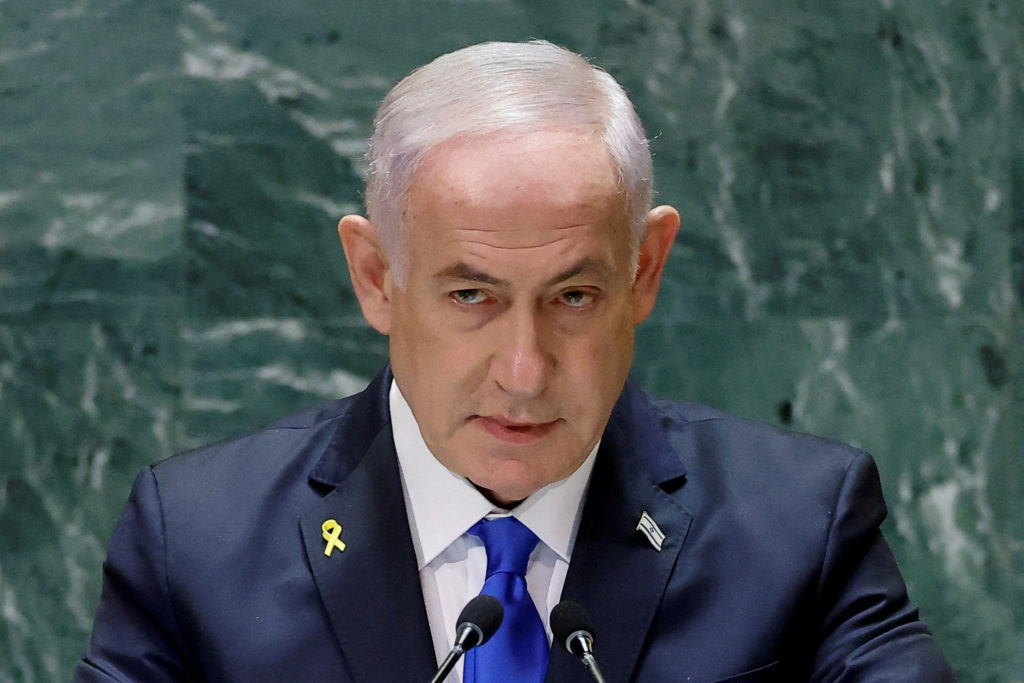
Netanyahu says Israel and Hamas will enter ceasefire’s second phase soon

Israeli Prime Minister Benjamin Netanyahu said Sunday that Israel and Hamas are “very shortly expected to move into the second phase of the ceasefire,” after Hamas returns the remains of the last hostage held in Gaza.

Netanyahu spoke during a news conference with visiting German Chancellor Friedrich Merz and stressed that the second phase, which addresses the disarming of Hamas and the withdrawal of Israeli troops from Gaza, could begin as soon as the end of the month.

Hamas has yet to hand over the remains of Ran Gvili, a 24-year-old police officer who was killed in the Hamas-led Oct. 7, 2023, attack that sparked the war. His body was taken to Gaza.

The ceasefire’s second stage also includes the deployment of an international force to secure Gaza and forming a temporary Palestinian government to run day-to-day affairs under the supervision of an international board led by U.S. President Donald Trump.

A senior Hamas official on Sunday told The Associated Press the group is ready to discuss “freezing or storing or laying down” its weapons as part of the ceasefire in a possible approach to one of the most difficult issues ahead.

Netanyahu said few people believed the ceasefire’s first stage could be achieved, and the second phase is just as challenging.

“As I mentioned to the chancellor, there’s a third phase, and that is to deradicalize Gaza, something that also people believed was impossible. But it was done in Germany, it was done in Japan, it was done in the Gulf States. It can be done in Gaza, too, but of course Hamas has to be dismantled,” he said.

The return of Gvili’s remains — and Israel’s return of 15 bodies of Palestinians in exchange — would complete the first phase of Trump’s 20-point ceasefire plan.

Hamas says it has not been able to reach all remains because they are buried under rubble left by Israel’s two-year offensive in Gaza. Israel has accused the militants of stalling and threatened to resume military operations or withhold humanitarian aid if all remains are not returned.

A group of families of hostages said in a statement that “we cannot advance to the next phase before Ran Gvili returns home.”

Meanwhile, Israeli military Chief of Staff Lt. Gen. Eyal Zamir on Sunday called the so-called Yellow Line that divides the Israeli-controlled majority of Gaza from the rest of the territory a “new border.”

“We have operational control over extensive parts of the Gaza Strip and we will remain on those defense lines,” Zamir said. “The Yellow Line is a new border line, serving as a forward defensive line for our communities and a line of operational activity.”

Merz said Germany, one of Israel’s closest allies, is assisting with the implementation of the second phase by sending officers and diplomats to a U.S.-led civilian and military coordination center in southern Israel, and by sending humanitarian aid to Gaza.

The chancellor also said Germany still believes that a two-state-solution is the best possible option but that “the German federal government remains of the opinion that recognition of a Palestinian state can only come at the end of such a process, not at the beginning.”

The U.S.-drafted plan for Gaza leaves the door open to Palestinian independence. Netanyahu has long asserted that creating a Palestinian state would reward Hamas and eventually lead to an even larger Hamas-run state on Israel’s borders.

Netanyahu also said that while he would like to visit Germany, he hasn’t planned a diplomatic trip because he is concerned about an arrest warrant issued by the International Criminal Court, the U.N.’s top war crimes court, last year in connection with the war in Gaza.

Merz said there are currently no plans for a visit but he may invite Netanyahu in the future. He added that he is not aware of future sanctions against Israel from the European Union nor any plans to renew German bans on military exports to Israel.

Germany had a temporary ban on exporting military equipment to Israel, which was lifted after the ceasefire began on Oct. 10.

The Israeli military said it killed a militant who approached its troops across the Yellow Line.

Gaza’s Health Ministry says Israeli forces have killed more than 370 Palestinians since the start of the ceasefire, and that the bodies of six people killed in attacks had been brought to local hospitals over the past 24 hours.

In the original Hamas-led attack in 2023, the militants killed around 1,200 people and took more than 250 others hostage. Almost all the hostages or their remains have been returned in ceasefires or other deals.

Israel’s offensive in Gaza has killed at least 70,360 Palestinians, according to Gaza’s Health Ministry, which operates under the Hamas-run government. The ministry does not differentiate between civilians and combatants, but says that nearly half the dead have been women and children. The ministry is part of Gaza’s Hamas government and its numbers are considered reliable by the U.N. and other international bodies. (JapanToday)

Posted on Leave a comment

Gaza talks to focus on releasing hostages all in one go, Netanyahu hints

Israel’s Prime Minister Benjamin Netanyahu has indicated that Gaza ceasefire efforts are now focused on a comprehensive deal to release all the remaining hostages at once.

The plan previously being pushed was for an initial 60-day truce and partial release of living hostages.

Hamas says a delegation of its leaders is in Cairo for “preliminary talks” with Egyptian officials.

Reports say that mediators see a window of opportunity in the coming weeks to try to push a deal through.

After indirect talks between Israel and Hamas broke down last month, Israel announced a controversial plan to widen its military offensive and conquer all the Gaza Strip – including the areas where most of its two million Palestinian residents have sought refuge.

However, Israeli media do not expect the new operation to begin until October – allowing time for military preparations, including a mass call-up of reservists.

Meanwhile, intense Israeli strikes have continued in Gaza, and the Hamas-run health ministry said at least 123 Palestinians have been killed in the past day.

Witnesses say that Israel has stepped up its attacks on Gaza City in particular with air strikes destroying homes.

Footage shows large explosions caused by the strikes and demolitions in the Zaytoun area, to the east of Gaza City.

Early on Wednesday, al-Shifa Hospital said seven members of one family, five of them children, were killed when tents were targeted in Tel al-Hawa, in the south of the city. Al-Ahli Hospital said 10 people were killed in a strike on a house in the Zaytoun area, to the city’s east.

The Israeli army said it had begun new operations in Zaytoun.

Israeli military chief Lt Gen Eyal Zamir also “approved the main framework for the IDF’s operational plan in the Gaza Strip”, a statement released by the army said.

In an interview with the i24News Israeli TV Channel shown on Tuesday, Netanyahu was asked if a partial ceasefire was still possible.

“I think it’s behind us,” he replied. “We tried, we made all kinds of attempts, we went through a lot, but it turned out that they were just misleading us.”

“I want all of them,” he said of the hostages.”The release of all the hostages, both alive and dead – that’s the stage we’re at.”

Palestinian armed groups still hold 50 hostages taken in the Hamas-led attack on 7 October 2023 that triggered the war. Israel believes that around 20 of them are still alive.

Netanyahu is under mounting domestic pressure to secure their release as well as over his plans to expand the war.

Last week, unnamed Arab officials were quoted as saying that regional mediators, Egypt and Qatar, were preparing a new framework for a deal that would involve releasing all remaining hostages at the same time in return for an end to the war and the withdrawal of Israeli troops.

However, this will be difficult to do in a short time frame as Israel is demanding that Hamas give up control of Gaza as well as its weapons.

This is likely to be why, at a news conference on Tuesday, Egyptian Foreign Minister Badr Abdelatty told journalists that Cairo was still “making great efforts” with Qatar and the US – the other mediators – to revive the earlier phased plan.

“The main goal is to return to the original proposal – a 60-day ceasefire – along with the release of some hostages and some Palestinian prisoners, and the flow of humanitarian and medical aid into Gaza without obstacles or conditions,” Abdelatty said.

The Israeli prime minister says Israel’s goals have not changed. He says that the war will end only when all hostages are returned and Hamas surrenders.

Netanyahu has said that, ultimately, Israel must keep open-ended security control over Gaza. (BBC)

Posted on Leave a comment

Trump says Israel has agreed to conditions for 60-day Gaza ceasefire

Israel has agreed to the “necessary conditions” to finalise a 60-day ceasefire in Gaza, US President Donald Trump has said.

In a post on Truth Social, Trump said that during the proposed ceasefire the US would “work with all parties to end the War”.He did not provide details on what the ceasefire would entail.

“The Qataris and Egyptians, who have worked very hard to help bring Peace, will deliver this final proposal. I hope… that Hamas takes this Deal, because it will not get better — IT WILL ONLY GET WORSE,” Trump wrote.

Israel has not confirmed it agreed to the conditions of a deal. A Hamas official told the BBC the group is “ready and serious” to reach an agreement if it ends the war.

Hamas is “prepared to agree to any proposal if the requirements for ending the war are clearly met or if they lead to its complete end,” said Taher al-Nunu.

Israel’s foreign minister Gideon Sa’ar posted on X that there is majority support in the government “for a framework to release hostages,” and this opportunity “must not be missed.”

For Israel, the key component of any deal will have to be the release of most, if not all, hostages still being held in Gaza.

Of the 50 or so hostages remaining in captivity, more than 20 are still thought to be alive and their plight has been at the forefront of regular demonstrations in Israel calling for an end to the war.

A recent Israeli newspaper poll suggested that a significant majority of Israelis want the war to end – but polling on Wednesday, from the Israel Democracy Institute, also suggests that most Israelis still don’t trust Israeli Prime Minister Benjamin Netanyahu, or his intentions.

Netanyahu has for months insisted on “complete victory” over Hamas before ending the war. It’s unclear if his position will now change under renewed pressure from Washington – and the answer could be pivotal to reaching a deal.

Trump’s announcement comes before a meeting with Netanyahu scheduled for next week, in which the US president has said he would be “very firm”.

He earlier said that he believed Netanyahu wanted to end hostilities in Gaza. “He wants to. I can tell you he wants to. I think we’ll have a deal next week,” Trump said.

Hamas has already indicated it would be willing to agree to a ceasefire if it led to the end of the war. But without that provision, Hamas negotiators might question the value of releasing all the hostages if the Israeli military is likely to resume bombing Gaza.

Another consideration before an agreement can be signed – perhaps while Netanyahu is in Washington next week – is Hamas’s demand for a partial Israeli military withdrawal from Gaza, at least for the duration of the ceasefire.

The international community is also likely to lobby hard for the resumption of full-scale UN-backed aid deliveries into Gaza.

Prior to Trump’s announcement, Israel’s ambassador to the United Nations Danny Danon told the BBC Israel was “absolutely” ready for a ceasefire.

Speaking on the BBC News channel, Danon said that Hamas was “playing hardball”.

“We are putting pressure on Hamas, and if they will not come to the table, the only option we will have to bring back the hostages, is to apply more military pressure,” Danon said.

“The war will end when the hostages are back home,” he added.

Last week, a senior Hamas official told the BBC mediators have increased efforts to broker a new ceasefire and hostage release deal in Gaza, but that negotiations with Israel remain stalled. (BBC)