Posted on Leave a comment

Trump gets royal welcome in UK as he makes historic second state visit

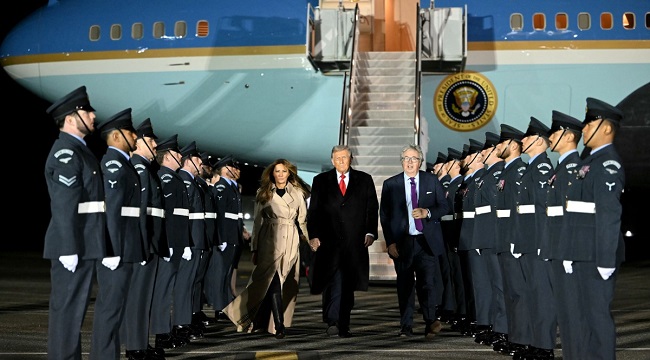
US President Donald Trump arrived in Britain on Tuesday for an unprecedented second state visit, with the UK government rolling out a royal red carpet welcome to win over the mercurial leader.

“A lot of things here warm my heart,” the 79-year-old Republican told reporters after he arrived with First Lady Melania Trump. “It’s a very special place.”

King Charles III will host Trump at Windsor Castle for a lavish banquet and carriage ride on Wednesday, before Trump meets Prime Minister Keir Starmer at his country residence on Thursday.

In a sign of the pomp and pageantry to come, a guard of honour greeted the Trumps as they stepped off Air Force One at Stansted Airport near London.

Trump then expressed his admiration for the British monarch.

“He’s been a friend of mine for a long time, and everyone respects him, and they love him,” Trump said as he arrived by helicopter at Winfield House, the US ambassador’s residence in London, where he will spend the night.

“Tomorrow’s going to be a very big day.”

Trump is the first US president to be invited for two state visits, after previously being hosted by Queen Elizabeth II during his last term in office in 2019 — as Britain tries to keep the so-called special relationship alive.

The British government has been unapologetic about its efforts to get on the right side of Trump, whose mother was Scottish and who owns a number of golf courses in the UK.

But the British public will be kept far away from Trump, with the visit taking place entirely behind closed doors and heavy security.

A large anti-Trump demonstration has been called in London on Wednesday, while protesters projected images of Trump and convicted sex offender Jeffrey Epstein onto the towers of Windsor Castle late Tuesday.

The shadow of the Epstein scandal has hung over Trump for weeks after his administration declined to release files on the issue. 

It has also embroiled British Prime Minister Keir Starmer, who sacked his ambassador to Washington Peter Mandelson on the eve of the visit over the envoy’s emails to Epstein.

Starmer’s government is however counting on the sheer scale of the state visit to keep Trump onside, despite his unpredictability over everything from tariffs to Ukraine and Gaza.

In Windsor on Wednesday, Trump will get a ceremonial carriage ride and a flypast by both UK and US jets in what officials call the largest military show for a state visit in living memory.

In the evening King Charles will host Trump for a lavish state dinner where both men will give speeches.

Trump may also relish the royal part of the visit as a chance to escape a turbulent period at home, where the killing of right-wing activist Charlie Kirk has caused turmoil.

Politics will take over again on Thursday when Starmer hosts Trump at his country residence Chequers for talks focusing on trade and the wars in Ukraine and Gaza.

The visit has been timed to line up with announcements of several investments in Britain — the latest being a pledge by Microsoft to spend $30 billion over four years.

Starmer needs the visit to go well after a miserable few days in which some in his Labour party have openly questioned whether he can remain as leader over the Mandelson resignation.

Downing Street has said Trump’s visit would see the “unbreakable friendship” between the countries “reach new heights”.

The visit is “a huge moment for both” men, said Evie Aspinall, director of the British Foreign Policy Group think-tank.

“For Trump, the state visit is an opportunity to revel in the pomp and ceremony he loves,” she told AFP.

“For Starmer, the visit is a chance to distract from domestic discontent and shift the limelight onto international issues where he has had greater success.” (France24)

Posted on Leave a comment

Shooting in occupied East Jerusalem kills six, Israeli authorities say

Six people have been killed in a shooting attack in occupied East Jerusalem, Israeli authorities say, as the Israeli military’s punishing assault on besieged Gaza rages alongside an accelerated violent crackdown by the army and settlers in the occupied West Bank.

Paramedics said at least 12 people were injured and six were in “serious condition” after the shooting on Monday morning at Ramot Junction. Several others were “lightly injured by glass” and treated at the scene, Israel’s paramedic service, Magen David Adom, said.

Israeli police described the shooting as a suspected “terror attack”.

A security officer and a civilian shot and killed the perpetrators soon after the shooting began, police confirmed.

The police said the perpetrators arrived in a vehicle and opened fire at a bus station.

Israeli forces closed all checkpoints between East Jerusalem and the occupied West Bank after the attack, sources told Al Jazeera.

After police said the perpetrators had come from the occupied West Bank, Israeli Army Radio reported Israeli forces imposed a military cordon on four villages in the Jerusalem governorate in the territory – Qatana, Biddu, Beit Inan and Beit Duqu – and conducted raids there.

The Israeli military said it had reinforced its forces in the wider Jerusalem area and was conducting a wide-ranging search for what it described as “accomplices” in the shooting.

Palestinians in the West Bank are preparing themselves to face collective punishment from Israel in retaliation for the attack, a Palestinian journalist said.

Speaking to Al Jazeera from the Aida refugee camp in the West Bank, Leila Warah said Palestinians were “very much on edge, waiting to see what is going to happen”. Prime Minister Benjamin Netanyahu has said Israeli forces are pursuing the villages where the attackers hailed from, in what was a now standard Israeli response to such attacks, said Warah.

Al Jazeera’s Hamdah Salhut – reporting from Amman, Jordan, because Al Jazeera is banned from East Jerusalem, the West Bank and Israel – said: “Israeli authorities are saying the two perpetrators are from an area in the occupied West Bank that is just west of occupied East Jerusalem. They say the two worked in tandem in this attack, that two gunmen boarded a bus – witnesses say one of them was dressed as a ticket inspector – and opened fire.”

“This attack took place near an illegal settlement of Ramot, just north of West Jerusalem, and if you look at where the Green Line is on a map, it actually bleeds into occupied East Jerusalem,” she added, referring to the generally recognised boundary between Israel and the West Bank. “These settlements are deemed illegal under international law and are buildings and structures that infringe on the rights of Palestinians and destroy territorial continuity for a future Palestinian state.”

“Israeli officials are now trying to wrap their heads around how exactly this happened, saying that they haven’t seen something like this happen in years, saying that the last shooting like this in greater Jerusalem was back in November 2023,” Salhut said.

Meanwhile, the Israel Hayom newspaper reported that Netanyahu informed judges that he would not attend his corruption trial session scheduled for Monday due to the security developments.

Both Netanyahu and far-right Israeli National Security Minister Itamar Ben-Gvir have visited the scene of the shooting.

“We are in an intense war against terror on several fronts,” Netanyahu said there. “I want to send condolences to the families of the dead and to the wounded. A pursuit and encirclement of the villages from which the terrorists came is under way.”

In reaction to the shooting, the Palestinian Authority (PA) has “reiterated its firm position of rejecting and condemning any targeting of Palestinian and Israeli civilians”. Its presidential office said in a statement from Ramallah in the occupied West Bank that the PA denounces “all forms of violence and terrorism regardless of their source”.

Neither Hamas nor the Palestinian Islamic Jihad has claimed responsibility for the shooting but have expressed “congratulations” for the attack.

Hamas said in a statement that the shooting was “a natural response to the crimes of the occupation and the genocide it wages against our people” and that it sends a clear message that Israel’s plans to “occupy and destroy Gaza City and desecrate Al-Aqsa Mosque will not pass without punishment”.

The group said Israel’s aggression against Palestinians in Gaza and the West Bank “will not weaken the determination of our people and their resistance” and called for more attacks in occupied territory.

The al-Quds Brigades, the armed wing of Palestinian Islamic Jihad, said in a short statement that the shooting was “a natural and legitimate response to the ongoing crimes of the Zionist enemy” in Palestinian territory.

The shooting most likely originated from the West Bank rather than from Hamas in Gaza, Israeli political analyst Ori Goldberg said.

Speaking from Tel Aviv, Goldberg told Al Jazeera he “seriously” doubted it had been ordered by Hamas.

If Hamas had carried out the attack, then it would mean Hamas was “trying to step up its resistance to what is beginning to look like a superimposed attempt to end the war”, he said, referring to comments from United States President Donald Trump’s administration that it is working on a solution to the war in Gaza.

Goldberg added that Israel has made some Palestinians feel that their only means of resistance is violence because Israel has done its utmost to ensure that they have no “sustainable model of politics”.

“Many Israelis ask where the Palestinian Nelson Mandela is at the moment, and the answer is either at a cemetery or in an Israeli prison. Israel has done everything it can to break any attempts on the part of the Palestinians to try and explore different paths, paths that are not violent like the ones we saw today,” he said, referring to the shooting.

Goldberg added that while Palestinians have also played a part in the failure of Palestinian politics, Israel is “by all means the stronger party” and bears most of the responsibility.

“Israel has done everything it can to break the Palestinian Authority, to arrest any semblance of a political leadership that might be amenable to a political process with Israel and to deny such a political process vehemently and repeatedly at all levels of the Israeli government,” he said. (AlJazeera)

Posted on Leave a comment

US suspends most visas for Palestinian passport-holders, reports say

US officials have further restricted visitor visas for Palestinians, by denying them to almost all applicants who use a Palestinian passport, media reports say.

The development comes days after 80 Palestinian officials were denied visas ahead of the United Nations General Assembly in New York.

Earlier in August, visitor visas were paused for people hoping to travel from the Palestinian territory of Gaza. This newly-reported decree would affect a wider group – including people living in the Israeli-occupied West Bank.

The Department of State did not explicitly confirm the move but said it was “taking concrete steps in compliance with US law and our national security”.

The decision was issued in a diplomatic cable dated 18 August, the New York Times and CNN reported.

US consular officers were told to refuse non-immigrant visas to “all otherwise eligible Palestinian Authority passport holders”, the communication was quoted as saying.

That would apply to Palestinians hoping to come to the US for a range of purposes, including for business, study or medical treatment.

The move meant that officials would be required to perform a further review of each applicant, which amounted to a blanket ban on issuing visas to Palestinians, the New York Times added in its report.

Palestinians who are able to make visa applications using other passports were said to be unaffected.

It is not clear what prompted the reported move, though the Trump administration has been steadfast in its support for Israel’s military campaign against Hamas in Gaza.

The news also follows last month’s announcements by a number of other US allies – including the UK, Canada and France – that they would recognise a Palestinian state on certain conditions. US Vice-President JD Vance has said Washington has “no plans” to follow suit.

The Trump administration has also cracked down on pro-Palestinian protests on university campuses.

The move represents a further toughening of the president’s stance on visas, following two earlier measures.

Palestinian President Mahmoud Abbas was among a group of dozens of Palestinian officials who were recently blocked from attending the UN General Assembly session in New York later this month, after US officials revoked his visa and accused the Palestinian Authority and Palestine Liberation Organisation (PLO), both of which Abbas leads, of undermining peace efforts.

And the Department of State said on 16 August it had paused approvals of visitor visas for Palestinians from Gaza specifically, so that a review could take place.

Hamas, which is designated as a terrorist group by the US, governed Gaza when hundreds of its armed fighters attacked Israel on 7 October 2023, killing about 1,200 people and taking 251 hostages. The attack triggered a massive and ongoing Israeli military offensive, in which at least 63,459 Palestinians have been killed, according to the Hamas-run health ministry.

The US visa policy has effectively been extended now to include people from the West Bank and wider Palestinian diaspora.

Asked about the latest move, a Department of State spokesperson’s statement said: “The Trump administration is taking concrete steps in compliance with US law and our national security in regards to announced visa restrictions and revocations for PA (Palestinian Authority) passport holders. We refer you to those public announcements for more information on those restrictions and revocations.

“Every visa decision is a national security decision, and the State Department is vetting and adjudicating visa decisions for PA passport holders accordingly.” (BBC)

Posted on Leave a comment

PM killed in Israeli strike, say Yemen’s Huthis

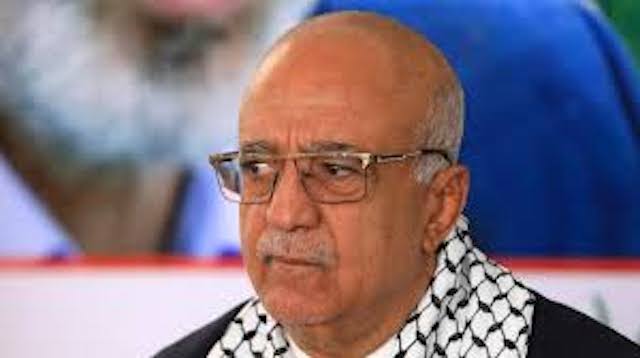
The prime minister of Yemen’s Huthis was killed in an Israeli airstrike along with other officials earlier this week, the Iran-backed rebels announced on Saturday.

Ahmed Ghaleb Nasser Al-Rahawi, who was appointed last year, is the most senior official known to have been killed in a series of Israeli strikes during the war in Gaza.

“We announce the martyrdom of the fighter Ahmed Ghaleb Nasser Al-Rahawi… along with several of his ministerial colleagues, as they were targeted by the treacherous Israeli criminal enemy,” a Huthi statement said.

“Others among their companions were injured with moderate to serious wounds and are receiving medical care since Thursday afternoon,” it added.

The Israeli military struck in the area of Sanaa, the Huthi-held capital, on Thursday. The Huthis, claiming solidarity with the Palestinians, have frequently fired missiles and drones at Israel during the Gaza war.

Israeli forces “struck a Huthi terrorist regime military target”, the Israeli military said at the time.

The Huthis have also targeted shipping in the Red Sea and the Gulf of Aden, which they claim is linked to Israel during the Gaza war.

The rebel group controls large parts of Yemen, which has been gripped by war since 2014, and is part of Iran’s anti-Israel alliance alongside militant groups across much of the Middle East. (Punch)

Posted on Leave a comment

Gaza talks to focus on releasing hostages all in one go, Netanyahu hints

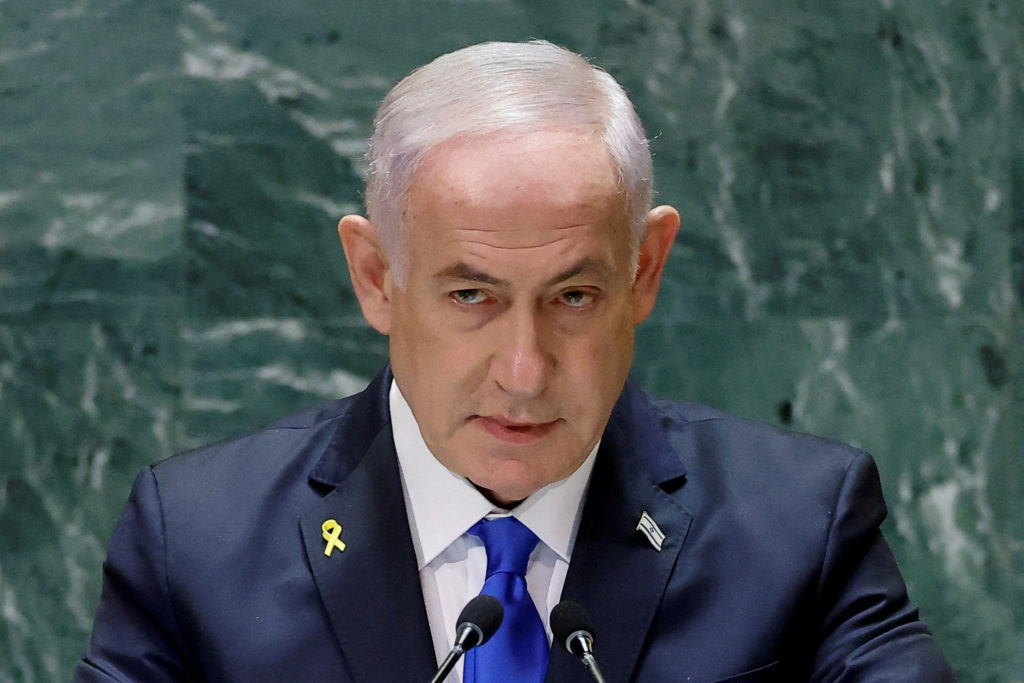
Israel’s Prime Minister Benjamin Netanyahu has indicated that Gaza ceasefire efforts are now focused on a comprehensive deal to release all the remaining hostages at once.

The plan previously being pushed was for an initial 60-day truce and partial release of living hostages.

Hamas says a delegation of its leaders is in Cairo for “preliminary talks” with Egyptian officials.

Reports say that mediators see a window of opportunity in the coming weeks to try to push a deal through.

After indirect talks between Israel and Hamas broke down last month, Israel announced a controversial plan to widen its military offensive and conquer all the Gaza Strip – including the areas where most of its two million Palestinian residents have sought refuge.

However, Israeli media do not expect the new operation to begin until October – allowing time for military preparations, including a mass call-up of reservists.

Meanwhile, intense Israeli strikes have continued in Gaza, and the Hamas-run health ministry said at least 123 Palestinians have been killed in the past day.

Witnesses say that Israel has stepped up its attacks on Gaza City in particular with air strikes destroying homes.

Footage shows large explosions caused by the strikes and demolitions in the Zaytoun area, to the east of Gaza City.

Early on Wednesday, al-Shifa Hospital said seven members of one family, five of them children, were killed when tents were targeted in Tel al-Hawa, in the south of the city. Al-Ahli Hospital said 10 people were killed in a strike on a house in the Zaytoun area, to the city’s east.

The Israeli army said it had begun new operations in Zaytoun.

Israeli military chief Lt Gen Eyal Zamir also “approved the main framework for the IDF’s operational plan in the Gaza Strip”, a statement released by the army said.

In an interview with the i24News Israeli TV Channel shown on Tuesday, Netanyahu was asked if a partial ceasefire was still possible.

“I think it’s behind us,” he replied. “We tried, we made all kinds of attempts, we went through a lot, but it turned out that they were just misleading us.”

“I want all of them,” he said of the hostages.”The release of all the hostages, both alive and dead – that’s the stage we’re at.”

Palestinian armed groups still hold 50 hostages taken in the Hamas-led attack on 7 October 2023 that triggered the war. Israel believes that around 20 of them are still alive.

Netanyahu is under mounting domestic pressure to secure their release as well as over his plans to expand the war.

Last week, unnamed Arab officials were quoted as saying that regional mediators, Egypt and Qatar, were preparing a new framework for a deal that would involve releasing all remaining hostages at the same time in return for an end to the war and the withdrawal of Israeli troops.

However, this will be difficult to do in a short time frame as Israel is demanding that Hamas give up control of Gaza as well as its weapons.

This is likely to be why, at a news conference on Tuesday, Egyptian Foreign Minister Badr Abdelatty told journalists that Cairo was still “making great efforts” with Qatar and the US – the other mediators – to revive the earlier phased plan.

“The main goal is to return to the original proposal – a 60-day ceasefire – along with the release of some hostages and some Palestinian prisoners, and the flow of humanitarian and medical aid into Gaza without obstacles or conditions,” Abdelatty said.

The Israeli prime minister says Israel’s goals have not changed. He says that the war will end only when all hostages are returned and Hamas surrenders.

Netanyahu has said that, ultimately, Israel must keep open-ended security control over Gaza. (BBC)

Posted on Leave a comment

France defends move to recognise Palestinian state

France defended its decision to recognise Palestinian statehood amid domestic and international criticism on Friday, including against the charge that the move plays into the hands of militant group Hamas.

President Emmanuel Macron said Thursday that his country would formally recognise a Palestinian state during a UN meeting in September, the most powerful European nation to announce such a move.

Macron’s announcement drew condemnation from Israel, which said it “rewards terror”, while US Secretary of State Marco Rubio called it “reckless” and said it “only serves Hamas propaganda”.

Mike Huckabee, US ambassador to Israel, quipped that Macron did not say where a future Palestinian state would be located.

“I can now exclusively disclose that France will offer the French Riviera & the new nation will be called ‘Franc-en-Stine’,” he said on X.

Hamas itself — which is designated a terrorist group by the United States and the European Union — praised the French initiative, saying it was “a positive step in the right direction toward doing justice to our oppressed Palestinian people”.

But French Foreign Minister Jean-Noel Barrot on Friday argued that Macron’s initiative went against what the militant group wanted.

“Hamas has always ruled out a two-state solution. By recognising Palestine, France goes against that terrorist organisation,” Barrot said on X.

With its decision, France was “backing the side of peace against the side of war”, Barrot added.

Domestic reactions ranged from praise on the left, condemnation on the right and awkward silence in the ranks of the government itself.

The leader of the far-right National Rally (RN), Jordan Bardella, said the announcement was “rushed” and afforded Hamas “unexpected institutional and international legitimacy”.

Marine Le Pen, the RN’s parliamentary leader, said the French move amounted to “recognising a Hamas state and therefore a terrorist state”.

On the other side of the political spectrum, Jean-Luc Melenchon, boss of the far-left France Unbowed party, called Macron’s announcement “a moral victory”, although he deplored that it did not take effect immediately.

By September, Gaza could be a “graveyard”, Melenchon said.

Interior Minister Bruno Retailleau, a right winger whose relationship with Macron is tense, declined on Friday to give his opinion, saying he was currently busy with an unrelated “serious topic” linked to the “security of French people on holiday”.

But the vice president of his Les Republicains party, Francois-Xavier Bellamy, blasted the decision as possibly “counter-productive” or, at best, “pointless”.

The move risked “endangering Israeli civilians” as well as “Palestinian civilians who are victims of Hamas’s barbarism”, he said.

Bellamy said that Macron’s move was a departure from the president’s previously set conditions for recognition of Palestine, which included a Hamas de-militarisation, the movement’s exclusion from any future government, the liberation of all Israeli hostages in Gaza and the recognition of Israel by several Arab states.

“None of them have been met,” he said.

Among people reacting to the news in the streets of Paris was Julien Deoux, a developer, who said it had been “about time” that France recognised Palestinian statehood.

“When you’ve been talking about two-state solutions for decades but you don’t recognise one of the two states, it’s a bit difficult,” he told AFP.

But Gil, a 79-year-old pensioner who gave only his first name, said he felt “betrayed” by his president.

“As a Frenchman, I’m ashamed to see that tomorrow Hamas could come to power in the territory,” he said.

While France would be the most significant European country to recognise a Palestinian state, others have hinted they could do the same.

Britain’s Prime Minister Keir Starmer announced he would hold a call on Friday with counterparts in Germany and France on efforts to stop the fighting, adding that a ceasefire would “put us on a path to the recognition of a Palestinian state”.

Germany, meanwhile, said on Friday it had no plans to recognise a Palestinian state “in the short term”.

Norway, Spain, Ireland and Slovenia all announced recognition following the outbreak of the Gaza conflict, along with several other non-European countries.

Once France follows through on its announcement, a total of at least 142 countries will have recognised Palestinian statehood. (Vanguard)

Posted on Leave a comment

Saudi Arabia slams Netanyahu’s suggestion it should host Palestinian state

Saudi Arabia has condemned Israeli Prime Minister Benjamin Netanyahu’s suggestion that the kingdom’s land be used to establish a Palestinian state.

In a statement on Sunday, the Saudi Foreign Ministry accused Netanyahu of attempting to “divert attention” from Israel’s ongoing “crimes” in Gaza, including “ethnic cleansing”.

“The kingdom affirms that the Palestinian people have a right to their land, and they are not intruders or immigrants to it who can be expelled whenever the brutal Israeli occupation wishes,” said the Foreign Ministry.

On Thursday, Netanyahu responded to an interviewer on Israel’s Channel 14 who misspoke by saying “Saudi state” instead of “Palestinian state”.

“The Saudis can create a Palestinian state in Saudi Arabia; they have a lot of land over there,” Netanyahu said.

The interviewer replied that it was an idea worth exploring.

The exchange drew angry reactions from Arab states, including Qatar, Jordan, Egypt, the United Arab Emirates, Kuwait and Iraq, as well as the six-nation Gulf Cooperation Council (GCC).

“These dangerous and irresponsible statements confirm the approach of the Israeli occupation forces in their disrespect for international and UN laws and treaties and the sovereignty of states,” said GCC Secretary-General Jasem Mohamed Albudaiwi.

The Saudi Foreign Ministry thanked the “brotherly countries” for denouncing Netanyahu’s remarks.

Discussions of the fate of Palestinians in Gaza had already been upended by an earlier shock proposal from United States President Donald Trump for the US to “take over” and “own” Gaza, resettling Palestinians elsewhere in a move that would amount to ethnic cleansing. That suggestion, amid a fragile ceasefire between Israel and Hamas in Gaza, has also been roundly condemned by Arab leaders.

Trump has also said Saudi Arabia would not require the formation of a Palestinian state as a precondition to normalise ties with Israel, a claim Riyadh has repeatedly denied.

Israel’s war on Gaza has killed at least 61,700 Palestinians including about 18,000 children, and wrecked much of the enclave’s infrastructure. More than 14,000 more people are missing and are presumed to be dead.

The Hamas-led attack on Israel on October 7 that sparked the war killed 1,139 people and seized more than 250 captives, dozens of whom are still believed to be in the enclave. (AlJazeera)