
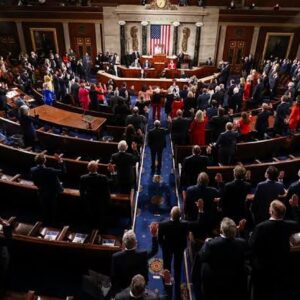
Voters in the United States have delivered a stunning rebuke of President Donald Trump, ushering in a new era of Democratic power that will transform not just the remainder of his presidency, but politics across the country for the foreseeable future.
Democrats re-took control of the US House of Representatives after Republicans wrestled the chamber away in 2022 amid post-pandemic inflation under former President Joe Biden.
Hakeem Jeffries, the Democratic House leader poised to become its first-ever Black speaker, heralded the results that, he claimed, proved “America is alive and well”.“Today begins the great American comeback”, Jeffries told supporters in Washington, DC, on Tuesday. “From sea to shining sea, the American people have spoken – and made clear – we’ve had enough of the extremism, enough of the corruption.
They want a Congress that’s going to deliver for the American people, and that is exactly what House Democrats will do.”
Democrats also routed Republicans in the US Senate, flipping at least six seats throughout conservative strongholds in Southern and Midwestern parts of the country to give the party full control of the US Congress.
Trump, who repeatedly told Republicans in the lead-up to the midterms to “pretend I’m on the ballot”, backtracked on those remarks as it became undeniable on Tuesday that his party had suffered grave losses.
“I wasn’t on the Ballot,” Trump posted to social media. “And if I was, we would have won IN A LANDSLIDE!”
Democratic gains cut across blue and red districts, giving the party full legislative control in Washington, DC.
While races were still being counted, the party appeared likely to garner north of 230 House seats, marking one of their largest majorities since former President Barack Obama’s first took office nearly 20 years ago.
“This isn’t a wave,” one Democratic official told Al Jazeera. “This is a tsunami.”
For the first time in 94 years, a Democrat will represent Kansas in the US Senate, after Adam Hamilton, a minister at the country’s largest Methodist congregation, scored a major upset over unpopular incumbent Republican Senator Roger Marshall.
In nearby Iowa, a state Trump won by 13 points just two years ago but has faced some of the harshest impacts from his unpopular tariff policy, Democrat Josh Turek claimed victory over former television journalist Ashley Hinson in the battleground Senate race.
Democrats also have new hope in the US South, which has, until now, proven elusive for the party amid strong Republican dominance.
Senator-elect Roy Cooper, a popular former two-term governor, delivered Democrats their first major win of the day in North Carolina, flipping a seat held by outgoing Republican Senator Thom Tillis.
Further south in Georgia, Senator Jon Ossoff cruised to re-election, while his fellow Democrat, Keisha Lance Bottoms, made history as the first Black woman elected governor.
“In sweeping and decisive victories, the American people have rebuked the depravity, corruption, and incompetence of the failed lame duck president, Donald J Trump,” Ossoff declared before scores of supporters in Atlanta.
“And if, at times these last two years, amidst the ceaseless onslaught of brutality and indecency, you doubted whether our republic would survive, let tonight’s results give you courage that the first light of dawn is on the horizon.”
Texas, a state that has seen rapid population growth in recent decades, allowed Democrats to pad their US Senate majority when James Talarico took victory over scandal-plagued Ken Paxton in a race that drew national attention for the level of spending and attacks.
But it is South Carolina, a deep-red state Trump won by 18 points two years ago, that delivered what might be the most unexpected, bruising loss for Republicans.
For the first time in nearly 30 years, a Democrat will now represent the state in the US Senate. Democratic Senate candidate Annie Andrews, a paediatrician, trounced Senator Darline Graham, who was appointed to fill her deceased brother Lindsey Graham’s seat.
“Nobody in Washington recruited me to run. Nobody handed me this seat. Nobody wrote my scripts,” Andrews told supporters in Charleston, South Carolina, as she spoke about her historic victory.
“I owe no one in Washington anything, but I owe the people of South Carolina everything. And that’s exactly who I’ll answer to.”
The same economic grievances that swept Republicans into power in Washington four years ago drove them out on Tuesday.
Polling from the Associated Press indicated voters were overwhelmingly frustrated, with the economy ranking as their top issue. About 4 in 10 said the economy was the most important issue facing the country, with most expressing concern about high petrol and grocery prices, which surged after the US launched a war on Iran in February.
Republicans, privately and publicly, argue this is what cost them the election. One party figure told Al Jazeera that the loss lies squarely on the shoulders of Trump’s defence secretary.
“[Pete Hegseth] sold the war to Trump, telling him it would be an easy win,” the source said. “He cost us this election.”
Trump was quick to blame his fellow Republicans – but not himself – for Tuesday’s historic losses.
“If Greg Abbott, the Governor of Texas, hadn’t become a RINO [Republican in Name Only] in the last six months of his Political Life, he wouldn’t have lost,” Trump posted on Truth Social on Tuesday. “He went back to his original formula, and it wasn’t pretty”.
Graham, in her concession speech after Andrews’d victory was announced, called for more introspection in her party, telling her supporters that “conservatives have more work to do”. (Al Jazeera)
 English