Posted on Leave a comment

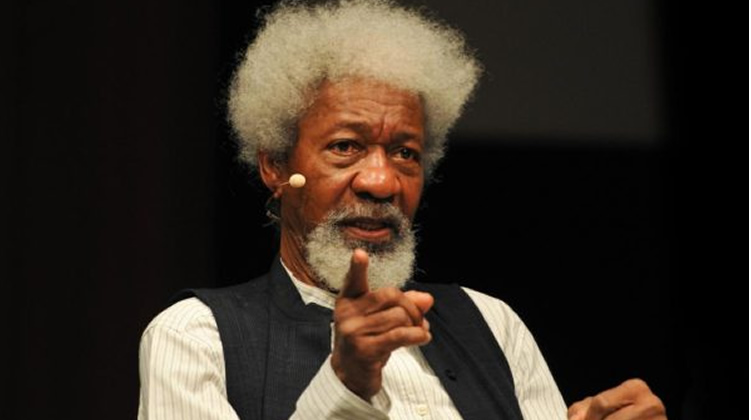
Nigerian Nobel laureate Wole Soyinka says US revoked his visa

Nigerian Nobel laureate Wole Soyinka has said the US revoked his visa and banned him from the country.

The 91-year-old author, who won the Nobel Prize for literature in 1986, said the US consulate asked him to bring in his passport so his visa could be cancelled in person as new unspecified information had come to light.

Soyinka called the invitation a “rather curious love letter from an embassy” in a news conference held on Tuesday and told organisations hoping to invite him to the US “not to waste their time”.

The US embassy in Nigeria has said it cannot comment on individual cases.

The Nobel laureate has previously held permanent residency in the US but renounced it in 2016, tearing up his green card in protest of President Donald Trump’s election.

The green card is a permanent residence permit for the US – prized by many African immigrants to the US.

Soyinka affirmed on Tuesday that he no longer had his green card – and jokingly added that it had “fallen between the fingers of a pair of scissors and it got cut into a couple of pieces”.

The famed author has had regular teaching engagements at US universities for the past 30 years.

“I have no visa. I am banned,” he said on Tuesday.

Soyinka has long been critical of the Trump administration’s radical stance on immigration and linked the visa revocation to his outspoken criticism.

He said his recent comparison of Trump to Uganda’s dictator – “Idi Amin in white face” – may have contributed to the current situation.

“When I called Donald Trump Idi Amin, I thought I was paying him a compliment,” Soyinka said, “he’s been behaving like a dictator.”

Idi Amin was a Ugandan military officer and dictator who ruled the country from 1971 to 1979, infamous for his brutal regime and widespread human rights abuses.

When asked if he would consider going back to the US, Soyinka said: “How old am I?”

In July, the US State Department announced sweeping changes to its non-immigrant visa policy for citizens of Nigeria and several other African countries.

According to the policy, nearly all non-immigrant and non-diplomatic visas issued to Nigerians and nationals of Cameroon, Ethiopia and Ghana would now be single-entry and valid for only three months, rolling back the up to five-year, multiple-entry visas they had enjoyed previously. (BBC)
Posted on Leave a comment

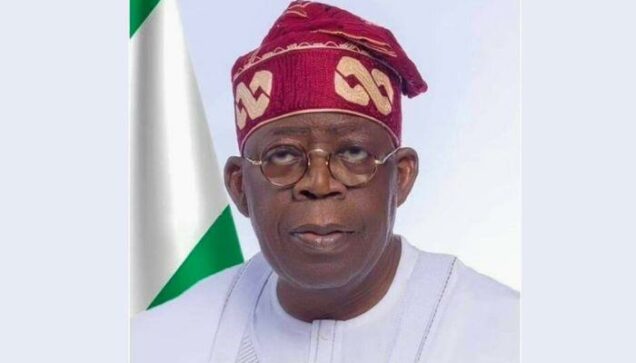
Tinubu: Stop negative talk, National Theatre revival shows Nigeria will succeed

President Bola Ahmed Tinubu, Wednesday, urged Nigerians to stop speaking negatively about the country, declaring that Nigeria is a nation of proud, confident, and dedicated people destined for success.

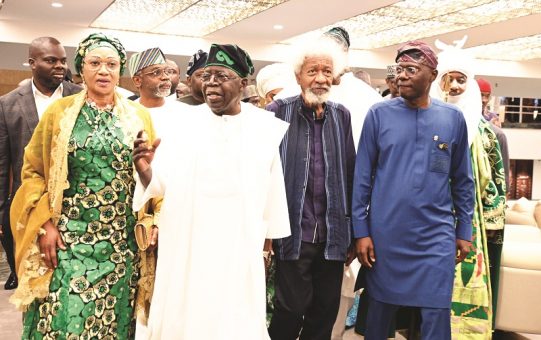
Speaking at the reopening of the renovated National Theatre, now the Wole Soyinka Centre for Culture and the Creative Arts, which coincided with the nation’s 65th Independence Anniversary.

Tinubu said the landmark’s revival was proof that the country could overcome setbacks and achieve greatness.

“Let’s believe in Nigeria, let’s put this country first. If you have a bad dream, forget it—Nigeria will succeed,” the President told the gathering, adding: “This is the giant of Africa; it won’t fall, it won’t disintegrate in my hands.”

Tinubu said the theatre’s rebirth must create jobs and expand opportunities in the creative economy. He directed CBN Governor, Olayemi Cardoso, and the Bankers’ Committee to set up an endowment fund, pledging his own contribution.

“The worst is over; we have turned the corner. With proper management, prosperity will come,” he assured.

 Speaking at the event, Governor of the Central Bank of Nigeria (CBN) said the transformation of the National Arts Theatre into the Wole Soyinka Centre for Culture and the Creative Arts is a strategic investment in Nigeria’s youths, Nigeria’s stories and rightful place on the global  cultural stage.

The CBN Governor explained that the ₦68 billion funding from the Bankers’ Committee was not corporate social responsibility but a deliberate stake in the creative economy.

“This is more than a building; it is an investment in our youths, in our stories, and in Nigeria’s rightful place on the global stage,” he said.

He recalled the Theatre’s FESTAC ’77 legacy, years of neglect, and its revival into a modern hub with world-class performance halls, cinemas, galleries, and upgraded facilities.

He commended President Bola Tinubu, Lagos State, and cultural partners, urging that the Centre remain a beacon of creativity and national pride.

Nobel Laureate, Prof. Wole Soyinka, has applauded the Bankers’ Committee for championing the transformation of the National Arts Theatre, describing it as a landmark rebirth of Nigeria’s cultural pride.

Soyinka said he accepted the honour with mixed feelings, warning against the indiscriminate naming of monuments after leaders. He recalled challenging a past ruler for dedicating a public space to “a brutal dictator.”

The playwright lamented the neglect of Africa’s theatre pioneers but praised those who turned the once-derelict complex into a world-class hub. With humour, he recalled how poor design once “nearly electrocuted actors” during performances.

Soyinka thanked President Bola Tinubu, Lagos State, and the Bankers’ Committee, urging that the revived theatre remain a stage for African creativity, unity, and global cultural expression.

Governor Babajide Sanwo-Olu has hailed the restoration of the National Arts Theatre, now renamed the Wole Soyinka Center for Culture and Creative Arts, as a landmark in Nigeria’s cultural revival.

Sanwo-Olu said the theatre, once host to FESTAC ’77 but later abandoned, has been restored through federal, state, and private collaboration. He described it as a foundation for future creative possibilities and a global hub for culture.

The renaming honours Nobel Laureate Wole Soyinka, while Sanwo-Olu praised Tinubu’s support, calling the edifice a beacon of unity, pride, and Nigeria’s artistic rebirth. (Vanguard)

Posted on Leave a comment

Soyinka accepts National Theatre naming honour

Nobel laureate Wole Soyinka has accepted the renaming of Nigeria’s National Theatre in his honour despite his past criticism of public monuments named after individuals.

At the reopening of the refurbished venue in Lagos on Thursday, the 90-year-old playwright acknowledged “mixed feelings” about the Wole Soyinka Centre for Culture and Creative Arts, as the complex in Iganmu is now known.

“I am notorious for having criticised many appropriations of public monuments by some of our past leaders, where everything is named after them,” Soyinka said.

“However, when I examined the history of theatre in Nigeria, and the lack of recognition for my predecessors, I believe somebody has to carry the can.”

The renaming, announced in July 2024 by President Bola Tinubu’s administration without Soyinka’s prior knowledge, sparked debate given his opposition to self-glorifying tributes.

The National Theatre, built in the 1970s under military rule, had fallen into disrepair, which Soyinka once described as a “slum” unfit for cultural events.

He recalled a near-fatal incident in the 2000s when exposed wiring endangered actors during a performance of his play Camwood on the Leaves.

The building’s Bulgarian-inspired conical design, which he had mocked as a “general’s hat,” became a symbol of neglect.

On Thursday, Tinubu inaugurated the restored theatre, rehabilitated with funding from Nigerian banks after years of decay. Soyinka, who staged Death and the King’s Horseman there in 1977, praised the effort as a “tasty morsel” of redemption, reversing his earlier support for a private takeover.

The centre is expected to host international festivals and youth programmes aimed at strengthening Lagos’s creative sector.

Soyinka, Africa’s first Nobel literature laureate in 1986, used the event to recognise figures such as Hubert Ogunde and Duro Ladipo, who helped establish Nigerian theatre during colonial and post-independence periods.

A co-founder of the Orisun Theatre Company in the 1960s, Soyinka’s works, including The Bacchae of Euripides, combine Yoruba traditions with global themes. His activism, including imprisonment during the 1967–1970 Biafran War, has also defined his public life.

Tinubu described the naming as a tribute to a figure of rare stature. (Guardian)