
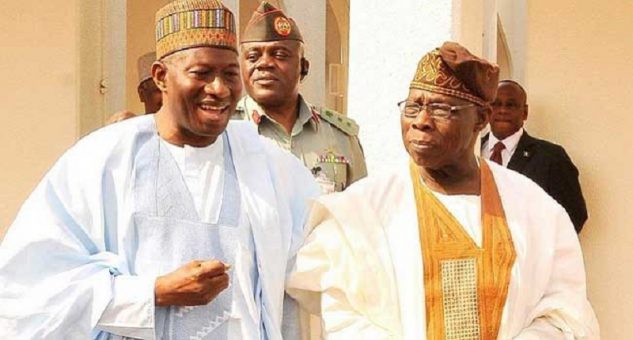
The challenge of leadership dominated deliberations on Thursday as regional leaders and diplomats examined issues confronting the African continent at the Murtala Muhammed International Lecture and Leadership Conference.
The lecture, themed “Has Africa Come of Age?”, drew an array of distinguished personalities, including former Presidents Olusegun Obasanjo and Goodluck Jonathan; former Vice President Yemi Osinbajo; former Ghanaian President John Kufuor; former Malawian President Joyce Banda; and former Sierra Leonean President Ernest Bai Koroma.
Obasanjo observed that one of the enduring legacies of the late General Murtala Muhammed was the emergence of capable successors who sustained his vision and development agenda. He acknowledged that successive administrations, including his own, had not effectively replicated that standard.
According to him, the late leader ensured continuity by leaving behind individuals equipped to advance his ideas and reforms.
“We cannot make progress if we take two steps forward, one step sideways, and three steps back, which is what we have been doing,” Obasanjo said. “The failure of all leaders after Murtala, including myself, is that we have not been able to create successors who could go on after us.”
“I handed over to civilians, and their ideas were completely different from the ideas we handed over to them. I will give you just one example. By the time we left in July 1979, we wanted to be self-sufficient in rice production. We asked that a report be prepared on what was in the fields. The report showed that we would be self-sufficient in rice production that year.
“Based on that, we banned the importation of rice before we left the government. In October 1979, when the civilian administration came in, one of the first things they did was to lift the ban on rice importation so they could allocate import licences to their supporters and political associates.
“One of the barons, who obtained a rice import licence from America, ordered rice and then asked the suppliers to add $5 million to the cost. They did. He then went back to New York and demanded $2.5 million out of the $5 million. They refused and gave him only $1 million. He wanted $2.5 million but had taken no risk. So, they gave him $1 million.
“Since the lifting of the rice import ban in 1979, we have not recovered from it. That is why we are still importing rice today. These are the kinds of things that go wrong.”
The former president said what is needed right now is reform and building the capacity to produce for both local consumption and export.
“When I became elected president, cocoa production in Nigeria was 150,000 metric tons. We introduced a new system to boost production, and within four to five years, we were producing 450,000 metric tons; we tripled output.
“Today, I understand we are producing no more than 300,000 metric tons. That is not how Africa will come of age. We must grow at nine to 10 per cent Gross Domestic Product (GDP) annually to come of age”, he said.
On his part, Former President Goodluck Jonathan said, “While Murtala symbolised decisive leadership, our democratic future depends on strong institutions. These include credible electoral management bodies, independence of the judiciary, well-trained security officers, and accountable governance systems. Democracy requires vision rather than decree, persuasion instead of command, and it depends on institutions, not individuals.”
Jonathan, however, pointed out that Africa’s current challenge is the absence of a lasting democratic culture built on credible and transparent elections.
He said, “Such a culture must respect term limits, protect the independence of the judiciary, press freedom, and credible elections.”
Jonathan also added, “More importantly, it is essential to emphasize the transformative power of vision in leadership. General Murtala assumed office as Head of State at the very young age of 38. Despite a tenure of only 200 days, his achievements were profound because he was driven by a clear, unyielding vision for a greater and more prosperous Nigeria.
“The President we are celebrating today was Head of State at the age of 38. If we are looking for people who can run nations in Africa, we should look at the age within 30 and 40 years. That is the way you can be very vibrant, physically strong, and mentally sound. If they need to stay awake for 24 hours, they can, but if you subject an older person to that kind of stress, the person will spend 50 per cent of the time in the hospital.”
Jonathan urged African countries to lower age barriers and strengthen institutions that allow youth participation in governance.
Describing Africa as a predominantly young continent.
Jonathan said growing frustration among youths should not be mistaken for a rejection of democracy.
He said it reflects a demand that democracy must deliver opportunities, dignity, and justice, adding that where justice is absent, “there are fractures within democracy.
He anchored his argument on the legacy of the late Head of State, General Murtala Muhammed, who assumed office at the age of 38 and governed with what he described as clarity of purpose and selfless national vision.
According to Jonathan, Murtala’s brief but impactful leadership showed that age is not a barrier to effective governance when leaders are driven by patriotism and discipline.
“General Murtala Muhammed assumed office as Head of State at a very young age. Despite a tenure of only 200 days, his achievements were profound because he was driven by a clear, unyielding vision for a greater Nigeria,” he said.
He lamented the future of democracy in Africa, saying the continent cannot sustain democracy while excluding its most vibrant population.
He therefore called for a deliberate inclusion of the young people in decision-making and leadership positions, reinforcing support for the Not Too Young to Run movement.
He argued that leadership in the modern era requires physical strength, mental alertness, and stamina often found among younger leaders.
“If we are looking for people who can run nations in Africa, we should look at the age within our day and age. That is how you can be vibrant, physically strong, and mentally sound,” Jonathan said.
If Africa has come of age, Jonathan wondered why leaders spend 50 per cent of their time outside the country, stressing that in countries such as America, some governors do not leave the country throughout their tenure in office.
But the Secretary to the Government of the Federation (SGF), Senator George Akume, said leadership was not about physical age but about ideas.
Akume, who represented President Bola Tinubu at the occasion, commended the ideals of late Gen. Murtala Muhammed, saying, “He was not just a Nigerian but he loved the country and did so much to restore its glory. Nigerians will continue to remember him for his fight against corruption. He believed in Africa and fought for its liberation. He devoted lots of resources and there were results”
He also commended the late Murtala for putting in place a programme to return the country to democracy before his assassination.
He also pleaded with Nigerians not to despair, noting that the government is working towards implementing its set goals.
In her welcome address, the Chief Executive Officer, MMF and daughter of Mohammed, Dr. Aisha Mohammed-Oyebode, said, “It was about who controls your resources, who shapes your policies, and whose interests define your future. Today, as we look across our continent, that question still challenges us.
“We are politically independent, yet we are still negotiating economic dependence. We are rich in talent and resources, yet still confronting inequality and fragility. We are young, dynamic, and globally connected, yet we are often uncertain about the leadership structures that are meant to serve our people”, she said.
The Keynote Speaker and former Vice President, Professor Yemi Osinbajo, eulogized Muhammad for capturing the imagination of the nation through the sheer clarity of his reforms, adding that he purged the civil service to confront corruption and inertia, probed military governors, and seized illicitly acquired properties.
“Yet it was his declaration that Africa had come of age that immortalized him, the speech that he made 34 days before he was assassinated”, he said.
“He was speaking of the awakening of responsibility, identity, and self-determination, and his context was the generational obligation of African leadership of his era to fight the viciousness of neocolonialism as those before them had fought colonialism. He was summoning the high values of integrity, dignity, and individual autonomy, by virtue of which African people, like others, had a right and an obligation to determine their own destinies and who they chose to undertake that journey with”, Osinbajo said.
Also speaking on whether Africa has come of age, former President of Ghana, John Kufuor, said the real question should be whether Africa today stands in the world with a settled sense of identity, responsibility, and purpose, not only as a political space but as a moral presence within humanity. (Nation)
 English