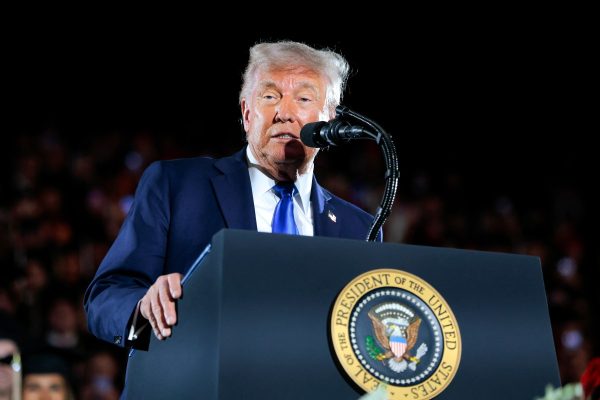
US President Donald Trump can keep collecting import taxes, an appeals court has ruled, a day after a trade ruling found the sweeping global tariffs to be illegal.
A federal appeals court granted a bid from the White House to temporarily suspend the lower court’s order, which ruled that Trump had overstepped his power by imposing the international duties.
Wednesday’s judgement from the US Court of International Trade drew the ire of Trump officials, who said it was an example of judicial overreach.
Small businesses and a group of states had challenged the measures, which are at the heart of Trump’s economic and international agendas.US President Donald Trump can keep collecting import taxes, an appeals court has ruled, a day after a trade ruling found the sweeping global tariffs to be illegal.
A federal appeals court granted a bid from the White House to temporarily suspend the lower court’s order, which ruled that Trump had overstepped his power by imposing the international duties.
Wednesday’s judgement from the US Court of International Trade drew the ire of Trump officials, who said it was an example of judicial overreach.
Small businesses and a group of states had challenged the measures, which are at the heart of Trump’s economic and international agendas.
In its appeal, the Trump administration said the decision issued by the trade court a day earlier had improperly second-guessed the president and threatened to unravel months of hard-fought trade negotiations.
“The political branches, not courts, make foreign policy and chart economic policy,” it said in the filing, which threatened to seek emergency relief from the Supreme Court if the earlier ruling was not put on hold.
Shortly before Thursday’s tariff reprieve from the appeals court, White House spokesperson Karoline Leavitt told a press briefing: “America cannot function if President Trump, or any other president, for that matter, has their sensitive diplomatic or trade negotiations railroaded by activist judges.” (BBC)
President Donald Trump signed an executive order Thursday directing the Corporation for Public Broadcasting to end federal funding for America’s two biggest public broadcasters, which have faced a series of attacks fromthe White House and Republican lawmakers accusing them of biased reporting.
The order instructs the CPB’s board to terminate direct funding for National Public Radio and the Public Broadcasting Service to the “maximum extent allowed by law and shall decline to provide future funding.” It also orders the board to take steps to “minimize or eliminate” indirect funding to NPR and PBS.
The corporation, however, is a private entity that is supposed to be protected from government interference, including executive orders from the president. The corporation is currently suing Trump because the White House tried to terminate three of its board members earlier this week.
“CPB is not a federal executive agency subject to the President’s authority,” the corporation’s CEO, Patricia Harrison, said in a statement. “Congress directly authorized and funded CPB to be a private nonprofit corporation wholly independent of the federal government.”
“The President’s blatantly unlawful Executive Order, issued in the middle of the night, threatens our ability to serve the American public with educational programming, as we have for the past 50-plus years,” PBS CEO Paula Kerger said in a statement Friday morning. “We are currently exploring all options to allow PBS to continue to serve our member stations and all Americans.”
Each year, the CPB disperses $535 million in taxpayer funds to public radio and TV stations nationwide and to producers of educational and cultural programming.
Stations, in turn, provide free and universal access to news, emergency alerts and a wide array of programming.
In Trump’s first term, his annual budget proposals zeroed out the funding for the corporation, but Congress always allocated the funds anyway – a reflection of the fact that national Republican opposition to NPR and PBS is countered by local support.
In Trump’s second term, he is being much more aggressive about trying to shut down the public broadcasters. The White House is alleging that the networks “spread radical, woke propaganda disguised as ‘news.’”
PBS and NPR executives reject that, but they recognize that Trump feels emboldened to pursue their federal funding.
The White House has said it will soon ask Congress to claw back the money already allocated for the corporation over the next two years.
“These are funds that we were already counting on,” PBS CEO Paula Kerger said earlier this week, “because it’s already appropriated. So we’re anxious to see what they’re talking about and we will be responding very quickly.”
House speaker Mike Johnson said of the expected rescission proposal, “I don’t know what the final outcome is going to be, but I can tell there’s a lot of thoughtful debate about it.”
Trump’s executive order is another pursuit of the same goal – a zeroing out of federal funding for public media.
The order also directs Health and Human Services Secretary Robert F. Kennedy Jr. to investigate NPR and PBS for possible employment discrimination, and it instructs the heads of all other federal agencies to “identify and terminate” any direct or indirect funding of the media organizations.
When Congress established the corporation in 1967, it specifically tried to insulate public media from political pressure.
The law said the corporation is a private entity, not a federal agency, “to afford maximum protection from extraneous interference and control.”
The legislation expressly forbids the government from exercising “any direction, supervision, or control over educational television or radio broadcasting.”
But Congress could choose to stop funding the corporation. In that case, bigger stations with lots of donors and other sources of revenue would survive, but smaller stations could be forced off the air, especially in rural areas that are Republican strongholds.
In many cases “these are the last locally owned broadcasters in these communities,” Ed Ulman, the CEO of Alaska Public Media, told CNN last month. (CNN)
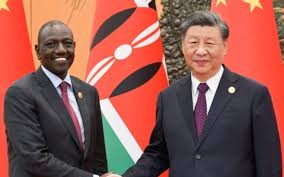
Kenyan President William Ruto has begun a five-day state visit to China, signalling a deepening of strategic and economic ties between the nations. Ruto’s first state visit to China since taking office in 2022 is being viewed by some as a strategic shift amid evolving geopolitical dynamics.
Ruto is expected to seek funding for key infrastructure projects, including the extension of the Standard Gauge Railway (SGR) to Malaba and a major highway project.
Deals worth €750 million have already been secured from seven Chinese companies, aimed at boosting Kenya’s manufacturing, agriculture and tourism sectors, according to Kenyan newspaper The Standard.
Trade between China and Kenya is on the rise, with a reported 11.9 percent increase in the first quarter of 2025. China is Kenya’s largest trading partner and top import source, while Kenya is China’s biggest trade partner in East Africa.
President Xi Jinping is scheduled to host a welcome ceremony and banquet for Ruto, with discussions focused on strengthening cooperation within the Global South. Ruto has also expressed Kenya’s interest in joining the BRICS intergovernmental group of emerging economies.
Faced with stalled funding from the United States and trade friction, Kenya has turned to China, according to analysts.
Adhere Cavince, a Nairobi-based international relations researcher, quoted by Hong Kong’s South China Morning Post, says that US tariffs and reduced aid have pushed Ruto to seek new markets and investment from China.
Cavince sees Ruto’s visit as a “symbolic” win for Beijing. “Beijing’s hosting of Ruto amid escalating geopolitical and trade tensions with the US is a win for China in terms of optics,” he said. “Nairobi is not just an option [for China], it is also a strong gateway to the rest of Africa.”
The Chinese foreign ministry said the visit will “contribute to deepening China’s relations with Kenya” and promote “solidarity and cooperation” within the Global South.
On 8 April, US President Donald Trump imposed a baseline 10 percent tariff on Kenya, as part of a wide range of import tax measures.
Six days later, Beijing’s embassy in Nairobi took to X (formerly Twitter) to post an image of Communist China’s founder Mao Zedong and his 1946 remark that: “The US intimidates certain countries, stopping them from doing business with us. But America is just a paper tiger. Don’t believe it’s bluff. One poke, and it’ll burst.”
Meanwhile, Kenya is also pivoting away from European investors. On 11 April, Reuters reportedthat Nairobi will terminate a €1.3 billion highway expansion deal with a consortium led by France’s Vinci SA, with the project expected to go to a Chinese contractor instead.
The deal to turn 140km of single-lane road into a multilane highway linking the capital Nairobi to the Rift Valley city of Nakuru was signed in Paris in 2020, during a visit by then-President Uhuru Kenyatta. (RFI)
Utah has become the first US state to ban the use of fluoride in its public water, following concerns raised by health secretary Robert F Kennedy that the mineral poses potential health risks.
Governor Spencer Cox signed the ban into law this week, which will go into effect on 7 May. Other states, including Florida and Ohio, are weighing similar legislation.
Fluoride has been added to US drinking water since 1945 to prevent cavities.
Utah’s move to remove the mineral has been criticised by experts, who worry it will have consequences for oral health, especially for children.
The bill, signed by Cox on Thursday, prohibits communities from adding fluoride to their public water supplies.
The law does not mention any public health concerns related to the mineral, but Republican state lawmaker Stephanie Gricius – who introduced the bill in the state legislature – has argued that there is research suggesting fluoride could have possible cognitive effects in children.
Gricius has said that her bill would give citizens a choice whether they want to consume fluoride or not.
This concern over fluoride was previously raised by Kennedy, the US health secretary, who said in November that “the Trump White House will advise all US water systems to remove fluoride from public water”.
He alleged the chemical found in toothpaste and regularly used by dentists “is an industrial waste associated with arthritis, bone fractures, bone cancer, IQ loss, neurodevelopmental disorders, and thyroid disease”.
Most public health experts have rejected these claims and alleged that Kennedy had cited data from studies conducted in countries with far higher levels of fluoride in their water systems than the US has.
The American Dental Association sharply criticised Utah for its decision, saying that it shows “wanton disregard for the oral health and well-being of their constituents”.
“It is disheartening to see that a proven, public health policy, which exists for the greater good of an entire community’s oral health, has been dismantled based on distorted pseudoscience,” the association’s president, Denver dentist Brett Kessler, said in a statement.
Many public health groups, including the American Academy of Pediatrics and the Centers for Disease Control and Prevention, have long supported adding small amounts of fluoride to drinking water.
The US Public Health Service reduced the amount of fluoride it recommended adding to water in 2015, but the federal government has encouraged states since the 1960s to add small amounts of the chemical to water to help prevent cavities and aid oral health. (BBC)
The US government agency that regulates television says it is opening an investigation into Disney’s diversity and inclusion practices, in the latest sign of pressure being applied to media firms.
Federal Communications Commission (FCC) chairman Brendan Carr sent a letter to Disney on Friday notifying the firm, and its ABC News unit, of the plan.
He said the move had been prompted by concerns that the company was promoting diversity “in a manner that does not comply” with government regulation.
A spokesperson for Disney said the company is reviewing the letter.
“We look forward to engaging with the commission to answer its questions,” a Disney spokesperson said in a statement.
The FCC’s investigation into Disney also comes amid a wider crackdown on DEI practices by the Trump administration, with impacts felt beyond the US.
French companies with US government contracts received a letter from the American embassy in France this week, asking them to sign on and comply with Trump’s executive order banning DEI programmes.
The order, the letter said, “applies to all suppliers and service providers of the US government, regardless of their nationality and the country in which they operate.”
In a letter addressed to Robert Iger, the chief executive of Disney, FCC chairman Carr said he wants to ensure that the media company “ends any and all discriminatory initiatives in substance, not just name”.
He added: “I want to determine whether Disney’s actions – whether ongoing or recently ended – complied at all times with applicable FCC regulations.”
Carr has been a member of the FCC since 2017 and was named to lead the agency by Trump in November.
Since being appointed to the post, he has ramped up scrutiny of media firms, launching probes of NPR and PBS and demanding information from Big Tech companies including Apple and Google, about their use of services that influence how news articles get ranked.
The FCC also announced investigations of Verizon and Comcast and its media unit, NBCUniversal over their diversity, equity and inclusion (DEI) initiatives.
Disney, best known for its cartoon classics and theme parks, made changes to its DEI policies earlier this year.
“While I have seen reports that Disney recently walked back some of its DEI programs, significant concerns remain,” Carr wrote in the letter.
“I want to ensure that Disney and ABC have not been violating FCC equal employment opportunity regulations by promoting invidious forms of DEI discrimination,” he said. (BBC)
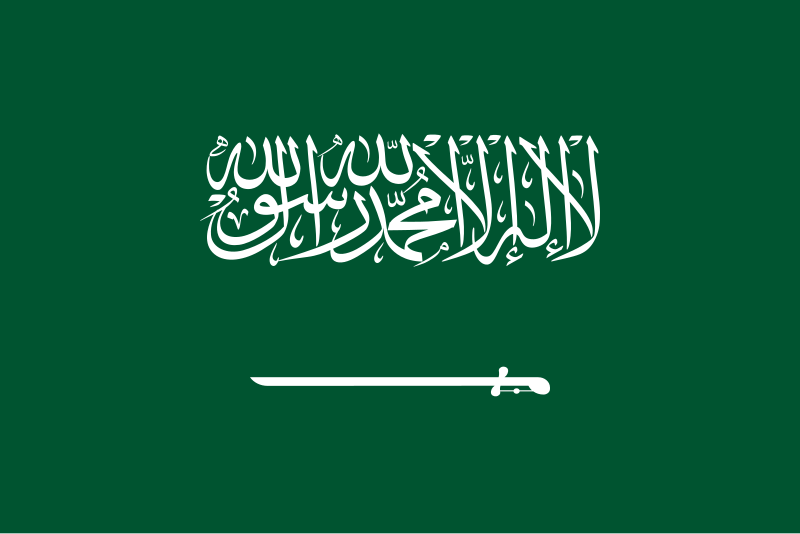
Saudi Arabia has condemned Israeli Prime Minister Benjamin Netanyahu’s suggestion that the kingdom’s land be used to establish a Palestinian state.
In a statement on Sunday, the Saudi Foreign Ministry accused Netanyahu of attempting to “divert attention” from Israel’s ongoing “crimes” in Gaza, including “ethnic cleansing”.
“The kingdom affirms that the Palestinian people have a right to their land, and they are not intruders or immigrants to it who can be expelled whenever the brutal Israeli occupation wishes,” said the Foreign Ministry.
On Thursday, Netanyahu responded to an interviewer on Israel’s Channel 14 who misspoke by saying “Saudi state” instead of “Palestinian state”.
“The Saudis can create a Palestinian state in Saudi Arabia; they have a lot of land over there,” Netanyahu said.
The interviewer replied that it was an idea worth exploring.
The exchange drew angry reactions from Arab states, including Qatar, Jordan, Egypt, the United Arab Emirates, Kuwait and Iraq, as well as the six-nation Gulf Cooperation Council (GCC).
“These dangerous and irresponsible statements confirm the approach of the Israeli occupation forces in their disrespect for international and UN laws and treaties and the sovereignty of states,” said GCC Secretary-General Jasem Mohamed Albudaiwi.
The Saudi Foreign Ministry thanked the “brotherly countries” for denouncing Netanyahu’s remarks.
Discussions of the fate of Palestinians in Gaza had already been upended by an earlier shock proposal from United States President Donald Trump for the US to “take over” and “own” Gaza, resettling Palestinians elsewhere in a move that would amount to ethnic cleansing. That suggestion, amid a fragile ceasefire between Israel and Hamas in Gaza, has also been roundly condemned by Arab leaders.
Trump has also said Saudi Arabia would not require the formation of a Palestinian state as a precondition to normalise ties with Israel, a claim Riyadh has repeatedly denied.
Israel’s war on Gaza has killed at least 61,700 Palestinians including about 18,000 children, and wrecked much of the enclave’s infrastructure. More than 14,000 more people are missing and are presumed to be dead.
The Hamas-led attack on Israel on October 7 that sparked the war killed 1,139 people and seized more than 250 captives, dozens of whom are still believed to be in the enclave. (AlJazeera)