
Posted on Leave a comment

Tunji Disu sets up committee on establishment of state police

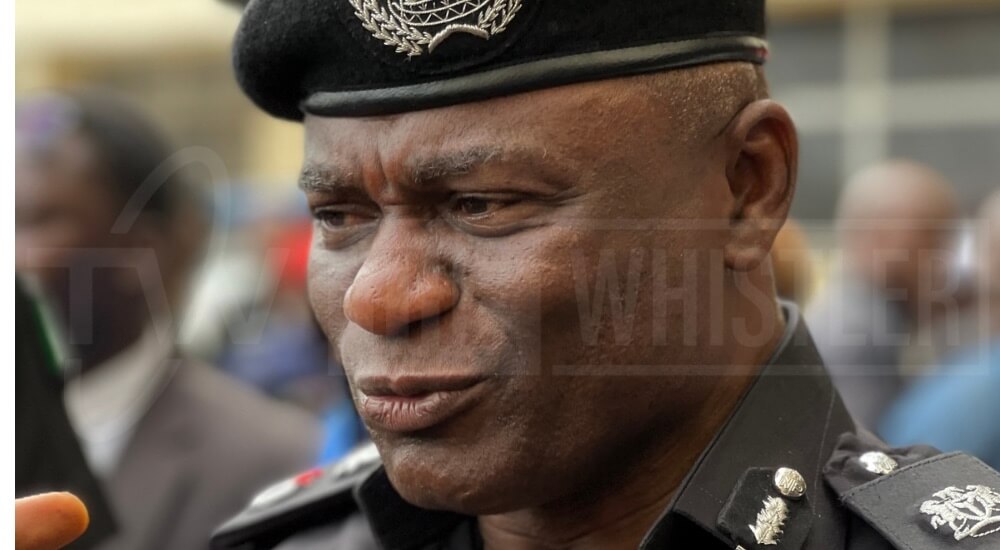
Tunji Disu, the inspector-general of police (IGP), has inaugurated a seven-member steering committee on the establishment of state police in Nigeria.

The committee, which will be led by Olu Ogunsakin, a professor of police studies, was inaugurated on Wednesday.

Speaking during the inauguration, Disu, who was recently appointed as IGP, asked the committee to propose an operational framework for the establishment and coordination of state police structures.

The IGP asked the committee to review issues pertaining to training, recruitment, resource allocation, and oversight mechanisms necessary for the state police structures.


Disu said the decentralisation of the police will enable state government and local authorities to respond to specific security challenges within their jurisdictions.

“It is my greatest privilege to formally inaugurate this committee on state policing. The task before this committee is both significant and timely as it speaks to our reflective demand to strengthen Nigeria’s security,” he said

“The committee we are inaugurating today has a critical responsibility. Your work will help shape the framework through which state policing may operate in Nigeria in a manner that strengthens, rather than fragments, our national security system.

“In carrying out this assignment, your deliberations must be guided by professionalism, objectivity, and a clear appreciation of the unique complexities of policing a diverse nation such as ours.

“Among other responsibilities, the Committee is expected to: review existing policing models within and outside Nigeria; assess community security needs and emerging risks across the country; propose an operational framework for the establishment and coordination of State Police structures; address issues relating to recruitment, training, standards, and resource allocation; develop robust accountability and oversight mechanisms to ensure professionalism and public trust.

“If thoughtfully designed and effectively implemented, State Policing holds significant potential benefits for our country.

“By bringing law enforcement closer to communities, state police institutions can deepen local knowledge of security dynamics and enable quicker and more targeted responses to emerging threats.”

Other members of the committee are Bode Ojajuni (secretary), Okebechi Agora, Suleyman Gulma, Ikechukwu Okafor, Tolulope Ipinmisho, and Emmanuel Ojukwu.

On numerous occasions, President Bola Tinubu has promised that his administration will create state police as part of the measures to address the country’s insecurity.

Recently, Tinubu asked both chambers of the national assembly to amend the 1999 constitution to create a legal framework for the establishment of state police.

The national assembly has commenced the process of amending the 1999 constitution to accommodate the establishment of state. (TheCable)
Posted on Leave a comment

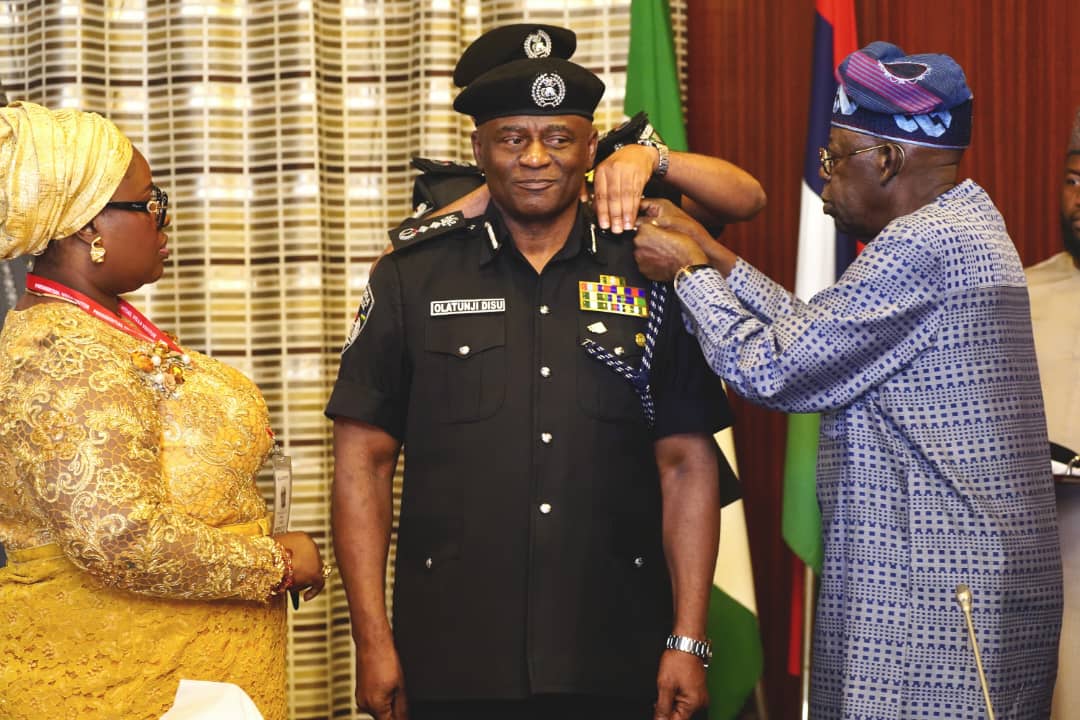
Tinubu decorates Disu as Acting IGP

President Bola Tinubu has decorated Acting Inspector-General of Police, Mr Tunji Disu with his new rank at the State House, Abuja.

The decoration ceremony, which followed his swearing-in, took place at the first floor office of the President during an expanded session attended by top government and security officials including National Security Adviser (NSA), Nuhu Ribadu; Chief of Staff to the President, Hon Femi Gbajabiamila; Secretary to the Government of the Federation, Senator George Akume, and the immediate past IGP, Kayode Egbetokun.

Tinubu, who pinned the new insignia on Disu’s uniform commended the outgoing IGP Egbetokun for his service to the nation.

Disu’s appointment came just 48 days before his scheduled retirement on April 13, 2026, when he would have reached the mandatory retirement age of 60 years.

However, under the amended Police Act, which allows Inspector-General of Police to serve a four year tenure regardless of age, Disu may remain for the next couple of years.

Until his elevation, Disu served as Assistant Inspector-General of Police at the Force Criminal Investigation Department (FCID) Annex, Alagbon, Lagos.

He previously held strategic roles, including Commissioner of Police in Rivers State and the Federal Capital Territory (FCT), Abuja. (ThisDay)

Posted on Leave a comment

Disu replaces Egbetokun as 23rd Inspector-General of Police

A source within the Police Service Commission has told The Guardian that Kayode Egbetokun has been removed as the 22nd Inspector-General of Police by President Bola Tinubu.

According to the source, Egbetokun is expected to be replaced by Tunji Disu, an Assistant Inspector-General of Police recently posted to oversee the Force Criminal Investigation Department (FCID) Annex, Alagbon, Lagos.

The source disclosed that Egbetokun was at the Presidential Villa on Monday, February 23, 2026, where he was reportedly directed to begin preparations for the handover of office.

Egbetokun’s tenure as Inspector-General was marked by a series of controversies, with his extended stay in office, despite statutory retirement provisions, forming the centrepiece of public criticism.

His tenure was extended beyond the mandatory retirement threshold of 60 years of age or 35 years in service, a move that drew sustained criticism from civil society groups, legal experts and commentators. Critics argued that the extension violated established police service rules and undermined institutional discipline.

Among the controversies that trailed his leadership were allegations surrounding the promotion of Bukola Kuti to the rank of Assistant Commissioner of Police. Critics alleged that her perceived closeness to the Inspector-General conferred undue advantage, fuelling accusations of favouritism and nepotism within the Nigeria Police Force. These allegations were denied by police authorities.

Further controversy arose following claims that ₦100 million from Anambra State’s security vote was traced to the bank account of Victor, Egbetokun’s son. The allegation sparked widespread public concern over the possible diversion of state security funds for personal benefit.

Rather than permitting an independent investigation into the claims, critics alleged that police authorities deployed institutional resources to pursue legal action against individuals and media platforms that reported the matter, deepening suspicions of corruption and abuse of office. Police authorities, however, maintained that the reports were defamatory.

During this period, Egbetokun’s office was repeatedly in the news over legal actions against journalists and activists. He initiated multiple charges against activist Omoyele Sowore and SaharaReporters after Sowore publicly described him as an “illegal IGP.”

The dispute escalated into protracted legal battles, with the Federal High Court issuing injunctions restricting further publications relating to Egbetokun and members of his family. Critics interpreted these court actions as attempts to stifle dissent and weaken press freedom.

Following additional reports on alleged promotions and financial improprieties, further court orders were issued restraining media organisations from publishing reports concerning Egbetokun, his son Victor, and Bukola Kuti.

Observers argued that, rather than addressing the allegations through transparent and independent investigations, the police leadership appeared more focused on legal countermeasures against critics—reinforcing public perceptions of an embattled Inspector-General relying on state authority to defend personal and professional interests. (Guardian)