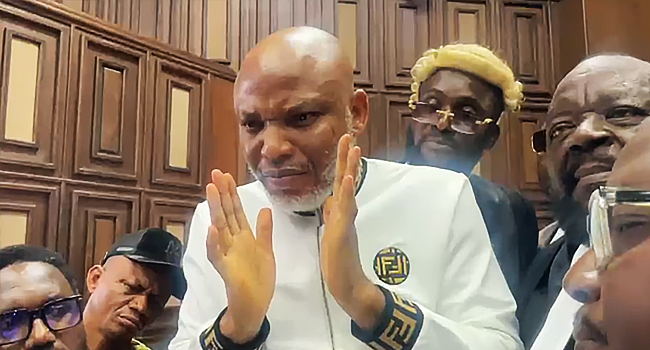

The Federal Government has asked the Federal High Court in Abuja to impose the death penalty on Nnamdi Kanu, leader of the proscribed Indigenous People of Biafra (IPOB), following his conviction on seven counts of terrorism on Thursday.
Justice James Omotosho, while delivering the judgment, ruled that the prosecution had proved its case against Kanu beyond reasonable doubt, finding him guilty on all seven charges.
Immediately after the conviction was pronounced, the Federal Government’s lead counsel, Adegboyega Awomolo, SAN, urged the court to impose the maximum penalty prescribed under the Terrorism Prevention (Amendment) Act, 2013.
Awomolo reminded the court that the law mandates a death sentence for several of the offences Kanu was convicted of.
“My Lord, consequent upon the conviction, nothing further remains but the lawful imposition of sentence. The punishment prescribed for the offences in Counts One, Two, Four, Five and Six, pursuant to Section 12H of the Terrorism Prevention Amendment Act 2013, is death,” Awomolo submitted.
“With all sense of humility, I say as a prosecutor that this court has no discretion in that regard. The only sentence Your Lordship can impose for Counts One, Two, Four, Five and Six is death, because the law empowers you to do so, and we expect that you will.”
Afterwards, the judge announced a recess, stating that the court would reconvene at 3:50 p.m.
Justice Omotoso is expected to announce the sentencing decision after considering the submissions of both parties. (Channels)
The Federal High Court in Abuja on Wednesday refused a bail application filed by five men accused of being members of the Al-Shabaab terrorist group and of carrying out the deadly attack on St Francis Catholic Church in Owo, Ondo State.
Recall, on June 5, 2022, during Pentecost Sunday Mass at St. Francis Xavier Catholic Church in State, which claimed the lives of more than 40 worshippers and left over 100 others injured.
On August 11, 2025, five suspects were arraigned before the Federal High Court in Abuja on nine terrorism charges. The men were alleged to belong to the Al Shabaab terrorist group and accused of plotting additional attacks. They all pleaded not guilty and were remanded in the custody of the Department of State Services.
The trial judge, Justice Emeka Nwite, dismissed the application, holding that the terrorism charges against the defendants were capital offences and that releasing them on bail would pose a significant security risk.
The defendants — Idris Abdulmalik Omeiza, Al Qasim Idris, Jamiu Abdulmalik, Abdulhaleem Idris and Momoh Otuho Abubakar — had, through their lawyer, Abdullahi Awwal Ibrahim, filed a bail application dated August 11, 2025 and argued on August 19.
Their counsel argued that the defendants had secured “reliable and responsible sureties” to stand for them if granted bail.
However, the plaintiff – the Department of State Services, represented by Dr Callistus Eze, opposed the application, warning that the men might abscond due to the gravity of the charges and the strength of evidence against them.
The DSS also argued that admitting them to bail could intimidate witnesses and jeopardise the trial.
Justice Nwite agreed with the prosecution, ruling that the defendants had failed to provide cogent and verifiable reasons for their release and had not presented credible sureties. He added that granting them bail would amount to “judicial risk”.
The judge also noted procedural defects in the bail application, pointing out that the names of the five defendants were not listed on the motion paper as required by law. In addition, the application was supported by a joint two-paragraph affidavit, contrary to the requirement that each defendant must provide a separate affidavit.
The five accused are facing multiple terrorism-related charges under the Terrorism (Prevention and Prohibition) Act, 2022, including Membership of Al-Shabab’s Kogi State cell, participation in meetings where the Owo church attack was planned.
Possession of Improvised Explosive Devices (IEDs) and AK-47 rifles, detonating explosives at St Francis Catholic Church in June. 5, 2022, resulting in the deaths of more than 40 people and injuries to over 100 others.
The horrific attack at St Francis Catholic Church shocked the nation and drew widespread condemnation both locally and internationally. It was one of the deadliest terrorist incidents in Nigeria in recent years, raising concerns about the spread of extremist networks beyond the North-East, where Boko Haram and ISWAP have been most active.
Justice Nwite ordered that the accused remain in DSS custody and granted an accelerated hearing of the case, fixing October 19, 2025, for the commencement of trial. (Punch)
A Federal High Court in Abuja on Friday ruled that the Nigerian Senate acted beyond its powers by suspending Senator Natasha Akpoti-Uduaghan for six months, ordering her immediate recall to the Red Chamber.
Justice Binta Nyako, who delivered the judgment, described the duration of the suspension as “excessive” and without a clear legal foundation.
According to the court, both Chapter 8 of the Senate Standing Orders and Section 14 of the Legislative Houses (Powers and Privileges) Act, which the upper chamber relied upon, do not stipulate a maximum suspension period. As such, they were deemed overreaching in this case.
The judge pointed out that since the National Assembly is only required to sit for 181 days in a legislative year, suspending a lawmaker for roughly that same length of time effectively silences the voice of an entire constituency—a move she described as unconstitutional.
“While the Senate has the authority to discipline its members, such sanctions must not go so far as to deny constituents their right to representation,” Nyako ruled.
However, the court sided with Senate President, Godswill Akpabio, on a separate issue, stating that his refusal to allow Akpoti-Uduaghan to speak during a plenary—on the grounds that she was not seated in her designated chair—did not amount to a violation of her rights.
Nyako also dismissed Akpabio’s argument that the judiciary had no business interfering in what he called an “internal affair” of the legislature, stating that fundamental rights and representation are matters squarely within the court’s purview.
In a twist, the court imposed a monetary penalty on Akpoti-Uduaghan for breaching a prior court directive that barred both parties from making public statements about the ongoing legal matter.
Justice Uche Agomoh of the Federal High Court, sitting in Ibadan, Oyo State, has convicted two social media influencers, Bukola Rufai and Abdulateef Jimoh, for abusing naira notes.
This was contained in a statement released by the Head of Media and Publicity, Dele Oyewale, on Wednesday.
The statement reads, “The convicts were prosecuted on a joint one-count charge that bordered on currency mutilation by the Ibadan Zonal Directorate of the Economic and Financial Crimes Commission.”
The charge read, “That you Bukola Rufai and Abdulateef Jimoh on or about the 25th day of September, 2024 within the jurisdiction of this Honourable Court, did match on Naira Notes, issued by the Central Bank of Nigeria and thereby committed an offence, contrary to Section 21 (3) of the Central Bank Act 2007 and Punishable under Section 21 (1) of the same Act.”
They pleaded “guilty” when the charge, following which the prosecution counsel, Lanre Suleiman, reviewed the facts of the case, tendered incriminating evidence and prayed the court to convict and sentence them accordingly, while the defence counsel, O.D. Ajadi told the court to temper justice with mercy, stating that the duo are first offenders and have become remorseful of their actions.
Agomoh convicted “both offenders without a sentence and gave them N50,000 option of fine each.”
The statement added that both convicts paved their way for arrest and prosecution when they made a video of themselves, spraying and trampling on Naira notes and posting it on TikTok. (Punch)