
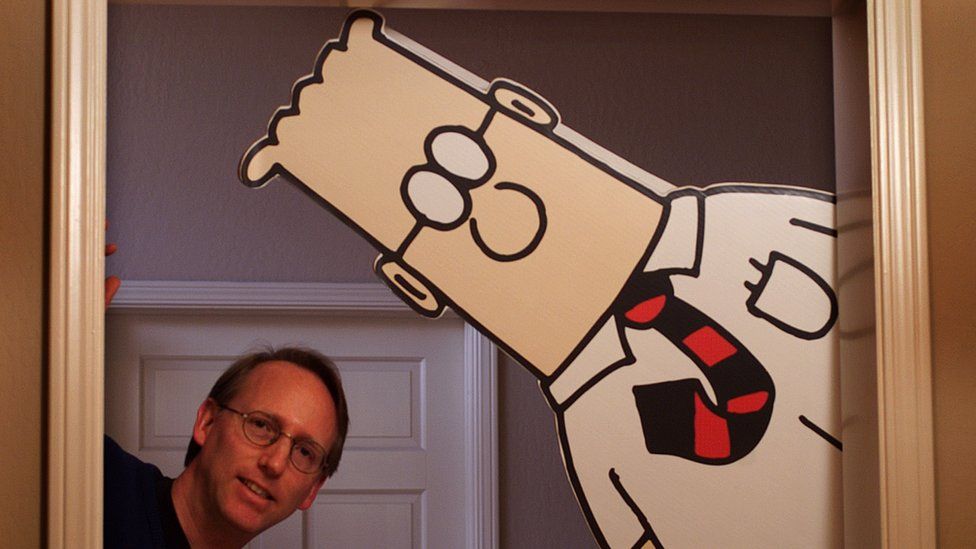
Scott Adams, the creator of the popular comic strip “Dilbert,” has died, according to an announcement on his social media pages.
Adams, who was 68, announced in May that he’d been diagnosed with an aggressive form of prostate cancer.
“Dilbert,” a chronicle of the indignities of American office work, was one of the country’s most widely read comic strips from its breakout success in the 1990s until February 2023, when Adams made racist comments against Black Americans, calling them a “hate group” that white people should “get the hell away from,” in response to a dubious poll about whether it’s “OK to be white.” Hundreds of newspapers stopped carrying “Dilbert” within days, and the strip was soon dropped by its distributor.
Adams, also a longtime outspoken supporter of President Donald Trump, began self-publishing the strip, in a “spicier version” called “Dilbert Reborn,” on his website for a subscription fee. He stopped personally drawing “Dilbert” in November 2025 due to cramping and partial paralysis in his hands, he said, though he continued to write scripts and have them illustrated for him.
Adams’ ex-wife Shelly Miles announced his death on Tuesday’s episode of the livestream “Coffee with Scott Adams,” which he hosted daily until his death, with a written statement from Adams.
“I had an amazing life,” Scott Adams wrote in the statement, composed on New Year’s Day. “I gave it everything I had. If I get any benefits from my work, I’m asking that you pay it forward as best as you can. That’s the legacy I want. Be useful, and please know, I loved you all to the very end.”
Adams, a New York native, worked as a bank teller from 1979 until 1986, the same year he graduated with an MBA from the University of California, Berkeley. (He was twice held at gunpoint as a teller, he wrote in the 20-year retrospective “Dilbert 2.0.”) He debuted “Dilbert” in 1989 while working as an engineer at the telephone company Pacific Bell, whose sterile setting and zany employees inspired his strip.
“For the future of ‘Dilbert,’ you could say that the group I was in was a target-rich environment,” he told EE Times, an electronics industry publication, in 2005.
“Dilbert” didn’t become a hit until a few years into its run, when Adams started to set most of its strips in his bespectacled office drone’s workplace. “It wasn’t exactly what I wanted to do, but it worked,” he told the Associated Press when he won the National Cartoonists Society’s Reuben award for the best comic strip of 1997.
He credited Dilbert’s blankness — his absence of visible eyes, for one, but also the lack of any particulars about his location or role at his company — with making the strip so popular.
“People have no reason to think it’s not just like their experience,” Adams told EE Times. “For instance, there are both engineers and programmers who are convinced Dilbert is one of them.”
And for decades, “Dilbert” was. Readers recognized their own upward-failing managers in Dilbert’s clueless “pointy-haired boss,” or identified with the everyman hero’s losing battle against incompetence in meetings with his dim coworkers. Adams included his email address in strips for years to gather stories from readers struggling in their own offices, material that “keeps me going,” he told the New Yorker in 2008.
Following the success of the strip, Adams felt unstoppable: “For a while, everything I touched turned to gold,” he told Bloomberg in 2017.
Confident in his ability to sell just about anything, he entered the food business, with much less success. In 1997, he opened a restaurant near his California home called Stacey’s Cafe. He eventually took over as boss at its sister location, where employees described him to the New York Times as “dramatically clueless about the harsh realities of the restaurant industry,” despite his years satirizing oblivious bosses. Both Stacey’s locations went “belly-up” sometime before 2017, Bloomberg reported.
He was also briefly the purveyor of the “Dilberito,” a frozen vegetarian burrito named for his cartoon and marketed as a nutrient-packed alternative to unhealthy microwavable meals. (The AV Club in 2020 remembered the product as “stomach-ruining.”) The Dilberito, launched in 1999, was discontinued in 2003. Adams told the New Yorker a few years later that “the world wasn’t interested in being healthy, so I got out of that business eventually.”
Adams started to become better known for his conservative politics when he began praising President Donald Trump in 2015, correctly predicting ahead of the 2016 election that Trump would win. Adams, who described himself as a “trained hypnotist,” said he found similarities between the persuasive methods of hypnosis and Trump’s rhetorical style.
He began blogging about Trump almost daily following the candidate’s 2015 debate against Hillary Clinton, and the new subject helped boost his readership, social media following (where he had a prolific presence up until his death) and TV news appearances.
“I could go on for pages about how Trump has good-but-not-world-class skills in a variety of areas,” he wrote on a now-defunct Dilbert blog, per Bloomberg. “And when you put all of those talents together it makes him the most persuasive human I have ever observed.”
His outspoken support for the president led to an invitation to the White House following Trump’s 2016 victory. The pair stayed in touch: In November, he publicly pleaded with the president for access to a new cancer treatment. Trump responded “on it.” Adams posted that he was scheduled to receive the drug two days after making the request, and he credited the Trump administration.
Adams began calling himself a “disgraced and canceled cartoonist” after “Dilbert” was pulled from syndication in 2023. His beliefs about race, though, had been visible well before that: In the 2005 EE Times interview, he said he “actually was told that as a Caucasian male, I had no future with the company,” referring to Pacific Bell, which he left in 1995, a few years after “Dilbert” debuted. He also wrote in “Dilbert 2.0” that the animated series based on his comic was canceled after two seasons because “the network made a strategic decision to focus on shows with African-American actors.” (CNN)
 English